
Carboxy Masks and Anti-Aging: What Makes This Luxury Facial Different
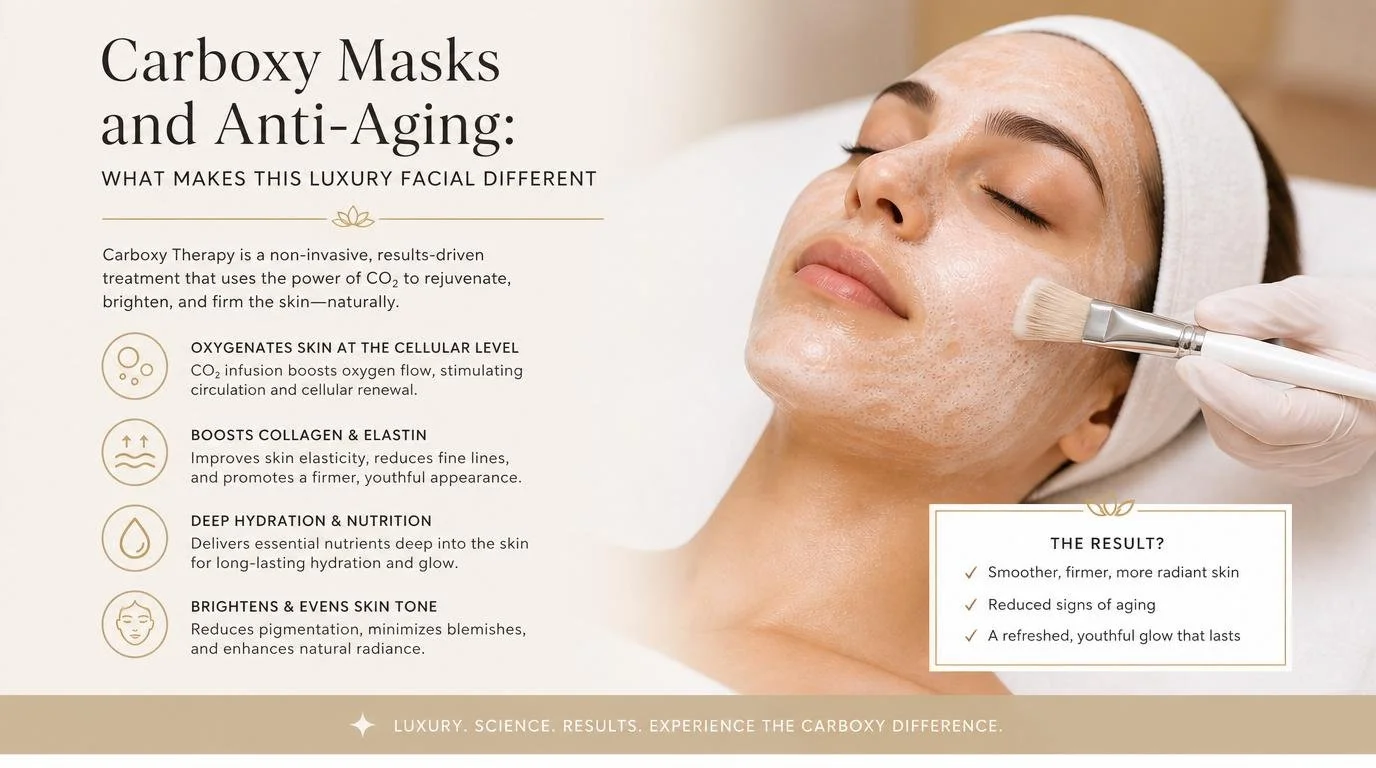
Most anti-aging treatments work by stimulating the skin to produce more of something it's already producing — collagen, elastin, hyaluronic acid — by creating a controlled injury or stress signal that the skin responds to. Microneedling makes tiny wounds. Chemical peels remove the outer skin layer. Retinoids accelerate cell turnover. Each of these is genuinely effective, and each relies on the same fundamental principle: provoke the skin, and the repair response produces the improvement.
Carboxy therapy works differently. It doesn't damage the skin. It doesn't remove anything. It changes the chemistry of the blood flowing through the skin's capillaries — temporarily, precisely, and in a way that produces multiple simultaneous effects that no other non-invasive treatment replicates. The mechanism is so distinct from everything else in professional skincare that it belongs in a different category entirely.
When I explain carboxy therapy to new clients at my studio in Boca Raton — available as a standalone treatment starting at $55, and as part of the $110 Luxury Facial protocol — the first thing I tell them is: this is not a mask that sits on top of your skin and hopes something penetrates. This is a mask that changes what's happening inside your skin's vascular system for the duration of its application and for days afterward. The difference is fundamental, and understanding it is what makes the results make sense.
The Chemistry Behind Carboxy — What CO2 Does Inside the Skin
The carboxy mask delivers carbon dioxide to the skin through a two-component system: a gel containing a carbonate compound is applied to the skin, and an activating sheet mask is pressed over it. The chemical interaction between the two releases CO2 at a controlled, sustained rate. This CO2 penetrates the superficial skin layers and enters the capillary bed — the network of tiny blood vessels that supply nutrients and oxygen to the dermal tissue.
What happens next is governed by physiology that has been understood since the 1930s.
CO2 in the capillary bed reacts with water in the blood plasma, forming carbonic acid: CO2 + H2O → H2CO3 → H⁺ + HCO3⁻. The formation of carbonic acid reduces the local tissue pH. This pH reduction triggers the Bohr effect — one of the fundamental mechanisms of oxygen delivery in human physiology. Christian Bohr described it in 1904: the lower the pH around hemoglobin, the weaker hemoglobin's bond to its oxygen molecules. The hemoglobin responds by releasing oxygen more readily into the surrounding tissue.
The result: a local flood of oxygen into the dermis. More oxygen per unit of blood flowing through the capillaries. More oxygen reaching the fibroblasts — the cells that produce collagen and elastin. More oxygen available for the enzymatic processes that synthesize structural skin proteins. All from a change in blood chemistry, without any injury to the skin, without any removal of tissue, without any of the controlled damage that other collagen-stimulating treatments rely on.
But the CO2-driven cascade doesn't stop there. The pH reduction also triggers vasodilation — the capillaries expand to accommodate increased blood flow. And research published in Applied Sciences (MDPI, 2025) — a narrative review covering carboxytherapy studies from 2020 to 2025 — documents a third effect that receives less attention but may be the most significant for long-term anti-aging results: neoangiogenesis.
Neoangiogenesis is the growth of new capillaries. The concentrated CO2 signal creates conditions that stimulate vascular endothelial growth factor (VEGF), which triggers the formation of new blood vessel branches in the treated tissue. This is not a temporary circulation boost — it is structural, lasting growth of new capillary infrastructure in the dermis. More capillaries mean better baseline oxygenation, better nutrient delivery, and better waste removal in the treated area, all of which persist long after the mask's immediate effects have faded. This mechanism distinguishes carboxytherapy's long-term skin quality improvement from the temporary flush that a circulation-stimulating massage produces.
Four Mechanisms, One Mask
The full picture of what carboxy therapy does to aging skin involves four distinct mechanisms operating simultaneously — which is why the results are difficult to replicate with any single other treatment.
First: Oxygen flooding. The Bohr effect releases oxygen from hemoglobin at levels above what normal tissue oxygenation provides. This oxygen pulse supports every energy-dependent process in the skin cells — cellular repair, protein synthesis, membrane integrity maintenance, the enzymatic reactions of collagen synthesis. For South Florida skin that carries UV-driven oxidative stress in the dermis, this oxygenation also provides the reducing capacity to address free radical accumulation that normal circulation can't fully clear.
Second: Vasodilation and increased blood flow. The capillary expansion from pH-driven vasodilation increases the volume of blood reaching the treated tissue. This brings nutrients, growth factors, and immune cells alongside the additional oxygen, creating what researchers describe as a "hypermetabolic state" in the local tissue — the skin is running faster, processing more, doing more repair work per unit of time than in its resting state. The visible manifestation of this is the characteristic post-carboxy glow: the skin looks pink, luminous, and distinctly alive in a way that products sitting on the surface cannot produce, because the change is coming from inside the capillary bed.
Third: Neoangiogenesis. The VEGF stimulation triggered by concentrated CO2 promotes capillary growth that persists after the mask's immediate chemical effect has resolved. Research on injectable carboxytherapy has documented this mechanism histologically — new capillary branches in the dermis, visible on biopsy, weeks after treatment. The topical carboxy gel produces increased microcirculation and capillary growth similar to injectable carboxytherapy, documented in clinical research published in the Journal of Clinical and Aesthetic Dermatology. For aging skin where capillary density in the dermis has declined — as it does with age and UV damage — this represents meaningful structural restoration of the skin's blood supply.
Fourth: Fibroblast activation and collagen synthesis. The increase in oxygen, nutrients, and growth factors reaching the dermis through the expanded and newly grown capillary network directly stimulates fibroblast activity. The 2023 Draelos & Shamban pilot study published in the Journal of Cosmetic Dermatology found improved skin hydration at four weeks and improved skin elasticity at ten weeks of CO2 mask use — the elasticity improvement at ten weeks reflects the actual collagen and elastin synthesis response, not a temporary surface effect. Histological studies on injectable carboxytherapy have documented elastic fiber synthesis and improved collagen fiber morphology following treatment, and the topical gel mechanism produces similar results through the same vascular pathway.
Additionally, the Draelos study and other research document a fifth mechanism specific to certain concentrations of CO2 application: adipocyte lysis — the CO2 disrupts the membranes of fat cells in the superficial tissue, releasing triglycerides into the intercellular space. This improves the mechanical elasticity of the skin by changing the composition of the tissue between structural fibers. It's a subtle effect in facial application, but it contributes to the improved skin texture and feel that clients report after a series of carboxy treatments.
The Dark Circles Case — Where the Clinical Evidence Is Strongest
Among all the aesthetic applications of carboxytherapy, the evidence for periorbital dark circles — the dark, hollow appearance under the eyes — is the most robust and the most consistently positive in peer-reviewed research.
Dark circles have multiple causes, which is why most treatments address them incompletely. The most common type in younger clients is vascular: the capillaries beneath the thin undereye skin are close to the surface, and the deoxygenated blood (which is darker than oxygenated blood) shows through the translucent skin. A second cause is hyperpigmentation from melanin accumulation — common in darker skin tones and in South Florida clients with significant UV exposure history. A third is structural: the loss of facial fat and collagen creates a hollow under the eye that shadows in natural lighting, creating the appearance of darkness even where actual pigmentation is normal.
Carboxytherapy addresses the vascular cause directly — the oxygenation effect literally brightens the blood flowing through undereye capillaries, changing the color of what shows through thin skin from deoxygenated blue-purple to oxygenated red-pink. Over time, the neoangiogenesis effect improves the vascular architecture beneath the eye, reducing the stagnant pooling of deoxygenated blood that creates the chronic dark appearance.
A 2024 clinical study published in the Journal of Cosmetic Dermatology (Tabaie et al.) evaluated carboxytherapy specifically for periorbital dark circles — and all patients reported significant reduction in the degree of dark circles after the third session, with results at a statistically significant p-value of less than 0.001. A prospective study of 35 patients receiving injectable carboxytherapy for dark circles found significant reduction in skin discoloration across all 35 patients, also with statistical significance (p < 0.00001). A 2024 review examining the impact of carboxytherapy on vascular and pigmentary components of dark circles found visible improvement in smoothing, surface texture, and general skin color — and reported that carboxytherapy combined with chemical peel produced superior results to either treatment alone.
The undereye area receives specific attention during carboxy treatment at my studio, particularly for clients whose dark circles are the primary concern. The topical mask applied to the orbital area triggers the same Bohr effect and vasodilation as on the rest of the face, with the added benefit that the thin, relatively poor-circulation tissue under the eye is particularly responsive to the capillary-level oxygenation effect.
Topical Mask vs Injectable Carboxytherapy — Honest Comparison
I want to be straightforward about the relationship between the topical carboxy mask and traditional injectable carboxytherapy, because clients who have researched the treatment sometimes ask about this.
Injectable carboxytherapy — the technique used in medical clinics since the 1930s — delivers CO2 directly into the subcutaneous tissue via a fine needle, typically at multiple injection points across the treatment area. The CO2 enters the tissue at higher concentration and with more direct access to the capillary bed. The neoangiogenesis effect, the fibroblast stimulation, and the collagen synthesis response are all more intense with injectable carboxytherapy than with the topical mask.
The topical carboxy mask delivers CO2 transdermally — through the skin surface rather than into the subcutaneous tissue. Research published in the Journal of Clinical and Aesthetic Dermatology documents that the topical application results in "increased microcirculation and capillary growth, similar to the changes observed following CO2 injections" — similar, not identical. The topical mechanism activates the same physiological cascade but at lower intensity than the injectable approach.
This means the topical mask requires more sessions to approach the results injectable carboxytherapy can achieve in fewer. For clients who want maximum collagen synthesis stimulation and aren't bothered by needles, injectable carboxytherapy produces faster, more dramatic results per session. For clients who prefer a non-invasive treatment with no injection, no discomfort beyond a mild tingling sensation, and no post-procedure healing considerations — the topical mask produces real, clinically documented results through the same mechanism, at a pace that rewards consistency.
The honest answer to "which is better" is: it depends on what you're treating, your tolerance for needles, and your expectations for the pace of results. What's not in question is that both work through a genuine physiological mechanism with real clinical evidence — the CO2 is actually doing what the research says it does, whether it enters through the skin surface or through a needle.
Where Carboxy Fits in the Treatment Menu — and When to Use It
I offer carboxy therapy in three formats at my studio, and the appropriate choice depends on what the client is trying to accomplish.
Standalone Carboxy Therapy — $55. This is the most accessible entry point: the carboxy gel mask applied to the face without the full facial treatment sequence. It produces the immediate oxygenation glow and begins the collagen stimulation process without the time commitment of a full session. Appropriate as a single-treatment addition before a specific event, as an introduction to the treatment to assess how a client's skin responds, or as an add-on to another service.
Carboxy Therapy Full Face — $65. A slightly extended version covering the full face more comprehensively, including the orbital area, with more attention to the application protocol that maximizes CO2 penetration across the entire treatment zone. This is the standalone carboxy treatment for clients whose primary focus is the carboxy mechanism rather than the full facial protocol.
As part of the $110 Luxury Facial. The carboxy mask in the Luxury Facial isn't a standalone treatment — it's the third mask layer in a sequence that includes the anti-aging formulation and the revitalizing mask, applied after the skin has been prepared by cavitation, frequency therapy, and lifting massage. The prepared skin — cleared of follicular congestion by cavitation, stimulated by frequency therapy, lymphatically drained by the lifting massage — receives the carboxy mask in a significantly different state than skin that hasn't been through this preparation. The vasodilation effect reaches cleaner, better-circulated tissue. The oxygenation reaches fibroblasts that have already been stimulated by the treatment sequence. The neoangiogenesis signaling happens in a tissue environment where the prior treatment steps have created better conditions for new capillary growth. The combined result is meaningfully different from the carboxy mask applied in isolation.
This is why the Luxury Facial produces a result clients describe as different in quality from any individual treatment they've had — not because any single element is extraordinary, but because the sequence creates compounding effects where each step improves the conditions for the next.
The South Florida UV Argument for Carboxy
I want to make a specific case for carboxy therapy in South Florida that goes beyond the general anti-aging conversation, because the mechanism is particularly relevant to the skin conditions that years in this climate produce.
UV exposure generates free radicals in the dermis that fragment collagen, damage cellular DNA, and accumulate as metabolic byproducts in the tissue. Normal capillary blood flow flushes this byproduct accumulation — but in skin where UV exposure is high and chronic, and where years of accumulated damage have reduced capillary density in the dermis (a documented consequence of long-term UV exposure), the flushing capacity of the tissue's own circulation is reduced. Metabolic waste accumulates faster than it's cleared. The result is the particular quality of skin that dermatologists describe as "photoaged" — not simply older-looking skin, but skin that has a specific texture, flatness, and subtle discoloration that reflects years of oxidative stress rather than just time.
Carboxy therapy addresses this directly. The vasodilation and increased blood flow flushes accumulated metabolic waste from the tissue. The neoangiogenesis effect begins rebuilding the capillary density that UV exposure has gradually reduced. The oxygenation provides the reducing capacity to address the oxidative burden that accumulated UV exposure leaves in the dermis. For South Florida clients who have been in this climate for years, the carboxy treatment is addressing something real and specific — not just stimulating collagen as a general anti-aging measure, but specifically addressing the vascular and oxidative consequences of the UV environment they've been living in.
This is why the clients who see the most dramatic carboxy results at my studio tend to be long-term South Florida residents in their forties and fifties: not because they're the right "age" for the treatment, but because they're the clients whose skin most specifically carries the vascular and oxidative consequences that carboxy therapy's mechanism most directly addresses.
What to Expect — During, Immediately After, and Over Time
The carboxy mask experience is distinctive from most other professional skincare treatments in that you can feel the mechanism working in real time.
During application, as the CO2 begins releasing from the gel and penetrating the skin, clients typically feel a light tingling — described variously as mild effervescence, the feeling of carbonated water on the skin, or a warmth that spreads gradually as the vasodilation begins. This tingling is direct sensory feedback of the CO2 reaction: the carbonic acid forming, the pH dropping, the capillaries beginning to dilate. Some clients find this pleasant; most find it interesting. It's mild enough that almost no client finds it uncomfortable.
The mask is pressed gently to maintain contact between the gel and the activating sheet — typically five to seven minutes for the initial reaction, with gentle pressure to ensure complete coverage. During this phase, clients often notice increasing warmth across the treated area as blood flow increases.
After the mask is removed: the skin is visibly different. Not dramatically, not in a way that looks done or treated — but in a way that reads as deeply oxygenated. Pink, luminous, more even-toned. Fine lines look softer because the plumping effect of increased tissue hydration from the improved blood flow. The overall impression is of skin that looks like it received several hours of deep sleep and clean mountain air simultaneously. This is not a metaphor. The mechanism literally oxygenates the tissue in a way that sleep and outdoor air partially replicate.
This immediate result — the glow — holds for five to seven days on average following a single treatment. Over a series of monthly treatments, the cumulative effect of fibroblast activation and early neoangiogenesis produces a baseline improvement that doesn't reset between sessions: the skin holds more collagen than it did, the capillary density in the treated area is greater than before treatment began, and the characteristic photoaging quality begins to improve gradually. Most clients who do a series of three to four monthly carboxy treatments describe a qualitative change in how their skin looks in photographs and in the mirror that feels different from what any other treatment they've done has produced — because the mechanism is genuinely different from anything else they've tried.
Standalone Carboxy Therapy is available starting at $55. Carboxy Full Face Treatment is $65. The carboxy mask is included as part of the $110 Luxury Facial. Book at heragencyusa.com — Phenix Salon Suites, 7112 Beracasa Way, Suite 119, Boca Raton. Serving Delray Beach, Coral Springs, Coconut Creek, Parkland, Pompano Beach, and across South Florida.
Frequently Asked Questions: Carboxy Mask and Anti-Aging Facial in Boca Raton
Q1: What is a carboxy mask and how does it differ from other anti-aging masks?
A carboxy mask is a two-component system — a gel containing carbonate compounds and an activating sheet mask — that releases carbon dioxide when the two components come into contact. The CO2 penetrates the skin's surface, reaches the capillary bed, and triggers a specific physiological response called the Bohr effect: CO2 reacts with water in the blood plasma to form carbonic acid, reducing local tissue pH and causing hemoglobin to release oxygen more readily into the surrounding tissue. The result is a controlled oxygenation of the dermis, vasodilation increasing blood flow, and over time, neoangiogenesis — growth of new capillaries in the treated tissue. This mechanism is fundamentally different from other anti-aging masks, which work through surface-level hydration, chemical exfoliation, or the delivery of topical actives. Carboxy masks change the internal chemistry of the blood supplying the skin rather than delivering anything to the skin's surface. The collagen and elastin stimulation that results comes from improved oxygenation and nutrition to the fibroblasts, not from a topical signal.
Q2: What does carboxy therapy do for aging skin — what specific improvements can I expect?
Carboxy therapy produces several distinct improvements in aging skin through its CO2-driven mechanism. Improved skin tone and radiance: the vasodilation and oxygenation effect produces an immediate brightening that reflects light differently from unglow skin — this holds for five to seven days per session. Reduced appearance of fine lines: the increased tissue hydration from improved blood flow and the collagen synthesis response over a series of sessions soften established fine lines. Improved skin elasticity: the 2023 Draelos & Shamban pilot study (Journal of Cosmetic Dermatology) found improved skin elasticity after ten weeks of CO2 mask use, reflecting actual collagen and elastin synthesis. Reduced puffiness: the lymphatic-like flushing effect of improved circulation reduces the fluid accumulation that creates morning puffiness and facial heaviness. For dark circles specifically: the oxygenation effect brightens the vascular component of dark circles, and the neoangiogenesis effect improves the capillary architecture that creates the chronic deoxygenated appearance under the eye.
Q3: Does carboxy therapy really stimulate collagen — is there clinical evidence?
Yes, with documented mechanisms and peer-reviewed evidence. The CO2-triggered oxygenation increases fibroblast activity — fibroblasts are more metabolically active in well-oxygenated tissue and produce more collagen and elastin as a result. Injectable carboxytherapy has histological evidence: studies have documented elastic fiber synthesis and improved collagen fiber morphology following treatment. For the topical carboxy gel, the 2023 Draelos & Shamban pilot study found improved skin elasticity at ten weeks — the ten-week timeline reflects actual structural collagen synthesis rather than temporary surface improvement. A 2025 narrative review in Applied Sciences (MDPI) covering carboxytherapy research from 2020 to 2025 found that "numerous clinical studies confirm that carboxytherapy significantly improves skin elasticity, tone, hydration, and structure through mechanisms such as improved oxygenation, stimulation of fibroblasts, and controlled inflammation." The neoangiogenesis effect — growth of new capillaries — also indirectly supports collagen production by improving the baseline nutrient and oxygen delivery to the fibroblasts between treatment sessions.
Q4: Can carboxy therapy help with dark circles — does it really work?
The clinical evidence for carboxytherapy specifically targeting periorbital dark circles is among the strongest in the treatment's research literature. A 2024 clinical study (Tabaie et al., Journal of Cosmetic Dermatology) evaluating carboxytherapy for dark circles reported that all patients experienced significant reduction in dark circle severity after the third session, with results statistically significant at p less than 0.001. A prospective study of 35 patients found significant skin discoloration reduction across all participants at p less than 0.00001. For the vascular type of dark circles — where the darkness comes from deoxygenated blood showing through thin undereye skin — carboxytherapy addresses the mechanism directly: the Bohr effect oxygenates the blood in the undereye capillaries, brightening their color, while neoangiogenesis over time improves the capillary architecture that creates the chronic deoxygenated pooling. For pigmentation-based dark circles, the improved circulation helps clear melanin accumulation. Results are cumulative over a series of sessions rather than complete after one treatment.
Q5: What is the Bohr effect and why does it matter for facial skin?
The Bohr effect is a fundamental principle of oxygen physiology described by Danish scientist Christian Bohr in 1904: hemoglobin's affinity for oxygen decreases as blood CO2 concentration increases or pH decreases. When carboxy therapy introduces CO2 to the skin's capillary bed, it forms carbonic acid, reducing local tissue pH. This weakened hemoglobin-oxygen bond causes the blood to release more oxygen into the surrounding tissue than it would under normal conditions. For facial skin, this means a controlled pulse of enhanced oxygenation to the dermis — more oxygen reaching the fibroblasts that produce collagen, more oxygen available for the enzymatic processes of protein synthesis, and the vasodilation response that increases blood flow. The Bohr effect is not a speculative mechanism; it's fundamental human physiology applied as a cosmetic tool. The CO2 that triggers it in carboxy therapy is the same molecule your own tissues produce during normal metabolism — the treatment is using a naturally occurring physiological signal in a concentrated, deliberate way.
Q6: What is neoangiogenesis and how does it make carboxy therapy different from other facials?
Neoangiogenesis is the growth of new blood vessels — specifically new capillaries — in the treated tissue. Research on carboxytherapy, including the 2025 MDPI review of studies from 2020 to 2025, documents that CO2 administration stimulates vascular endothelial growth factor (VEGF), a molecular signal that triggers new capillary formation. This effect distinguishes carboxytherapy from all other non-invasive facial treatments, which produce temporary circulation improvements without creating new capillary infrastructure. More capillaries in the dermis means permanently improved baseline oxygenation, better nutrient delivery to fibroblasts, and more effective metabolic waste clearance in the treated area — even between treatment sessions. For aging skin and UV-damaged South Florida skin where capillary density in the dermis has declined, neoangiogenesis represents structural restoration of the skin's blood supply rather than temporary stimulation of existing vessels. This is why clients who do a series of carboxy treatments describe a qualitative change in their baseline skin quality that persists between sessions, not just an effect that holds for a few days post-treatment.
Q7: Is carboxy therapy safe for all skin types including darker skin tones?
Carboxy therapy is one of the most universally safe skin treatments across all skin tones and Fitzpatrick types. The mechanism — CO2-triggered vasodilation and oxygenation — operates through blood chemistry rather than heat, light, or chemical exfoliation, which eliminates the primary causes of adverse reactions and post-inflammatory hyperpigmentation that make some treatments higher-risk for darker complexions. Research specifically cited safety across diverse skin populations. The treatment has no abrasion, no removal of tissue, and no heat generation at the skin surface. For South Florida's diverse population — which includes the full range of skin tones — this safety profile is particularly relevant. The tingling sensation during application is the only sensory effect most clients report. Temporary mild redness from vasodilation resolves within one to two hours and is normal evidence that the mechanism is working rather than a sign of irritation. Active inflammatory skin conditions, open wounds, and pregnancy are the primary contraindications, consistent with any professional skincare treatment.
Q8: How is the carboxy mask in the Luxury Facial different from the standalone carboxy treatment?
The carboxy mask in the $110 Luxury Facial is applied after the skin has been prepared by the full treatment sequence: cavitation has cleared follicular congestion, frequency therapy has stimulated circulation and killed bacteria in cleared pores, and the lifting massage has drained lymphatic congestion from the lower face and neck. The skin receiving the carboxy mask in this context is meaningfully different from unprepared skin: the capillaries have been pre-stimulated by the frequency therapy's circulation effect; the follicular channels are clear, allowing better transdermal CO2 penetration; the lymphatic congestion that can impede circulation in the tissue has been reduced by the massage. The carboxy mask in the Luxury Facial also follows the anti-aging and revitalizing masks rather than being applied to unprimed skin, creating a layered effect where each mask phase supports the next. The standalone carboxy treatments ($55 and $65) are the carboxy mechanism applied directly to unprepared skin — effective and clinically valuable, but not amplified by the preparation that the full Luxury Facial sequence provides.
Q9: How often should you get carboxy therapy for anti-aging results?
For anti-aging and general skin quality improvement, monthly sessions produce the most consistent cumulative results. The immediate glow from vasodilation and oxygenation holds five to seven days; the collagen synthesis and neoangiogenesis effects build over weeks and compound across sessions. A series of three to four monthly sessions produces the most visible cumulative improvement — the collagen synthesis from each session adds to what previous sessions have produced, and the neoangiogenesis effect is progressive rather than complete after any single treatment. For clients using carboxy specifically for dark circles, the clinical research protocol typically involves three sessions before assessing results, consistent with the Tabaie 2024 study showing significant improvement after the third session. After an initial series, maintenance at every four to six weeks sustains the capillary density improvement and continues the gradual anti-aging benefit. For South Florida clients dealing with ongoing UV-driven oxidative stress, monthly maintenance is the most sensible interval given that the UV conditions that depleted the skin's capillary density and collagen are continuing to operate year-round.
Q10: Where can I get carboxy therapy near me in Boca Raton?
Her Agency at Phenix Salon Suites, 7112 Beracasa Way, Suite 119, Boca Raton, FL 33433 offers three carboxy therapy options: standalone Carboxy Therapy at $55, Carboxy Therapy Full Face at $65, and carboxy mask as part of the $110 Luxury Facial Treatment covering face, neck, and hands. All treatments are performed in a private one-on-one session by a licensed medical esthetician with twelve years of experience. Services are available to clients throughout South Florida: Delray Beach, Coral Springs, Coconut Creek, Parkland, Pompano Beach, Deerfield Beach, and Fort Lauderdale. When researching carboxy therapy near you, ask specifically whether the treatment uses medical-grade CO2 gel formulation and whether the provider understands the Bohr effect mechanism rather than describing carboxy as simply "oxygenating" the skin — the distinction matters for treatment planning and for setting accurate expectations about results. Consultations and bookings at heragencyusa.com.
