
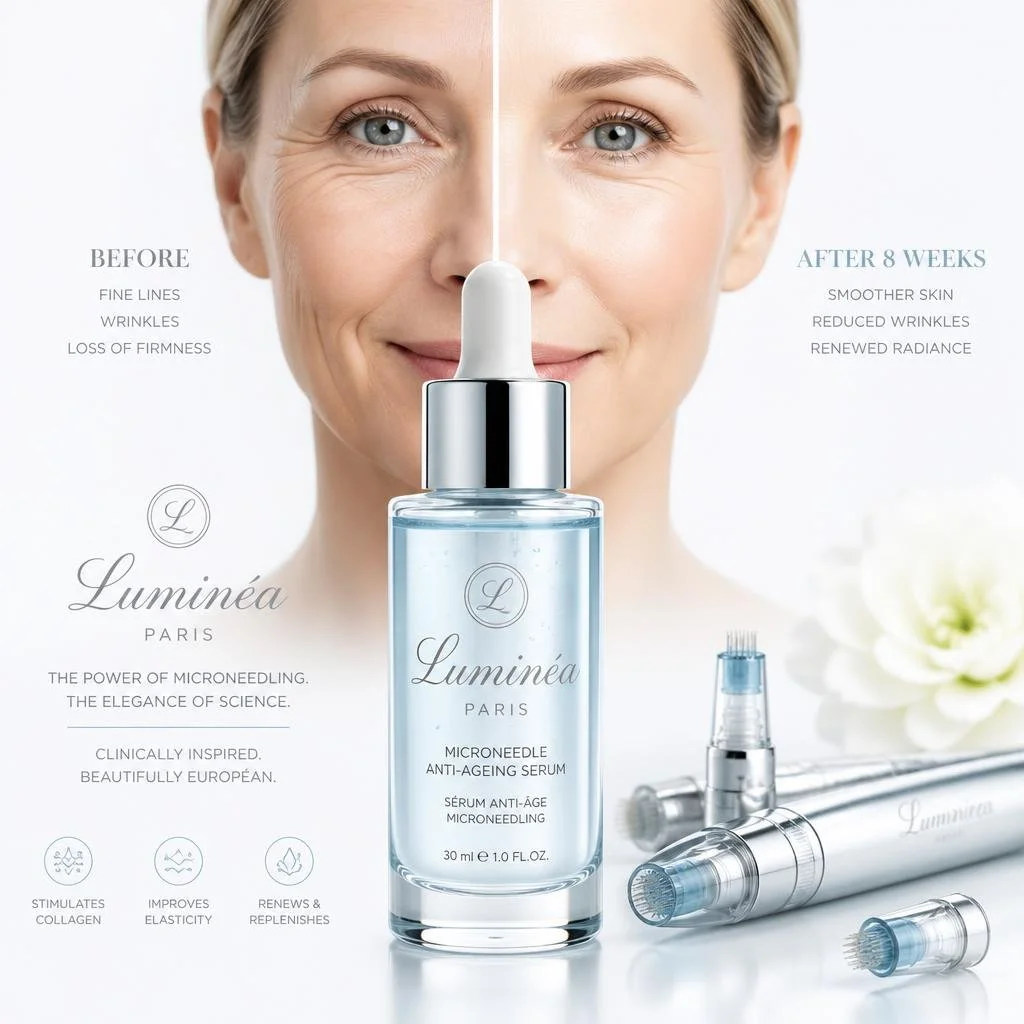
There's a moment in most skincare conversations when the word "European" appears, and something shifts.
It's a word that carries freight in the beauty industry — associations with restraint, with long-term thinking, with formulations that prioritize skin health over the dramatic quick-fix. Sometimes those associations are warranted. Sometimes they're just branding. And the difference between the two is worth understanding, especially when the question involves something going directly into your skin through open microneedle channels.
I use professional anti-aging serums during microneedling sessions at my studio in Boca Raton. Not because of where they're manufactured, but because of how they're formulated — and why the formulation standards that European cosmetic regulation demands produce a specific category of serum that genuinely behaves differently inside the treated skin. This is a conversation about what's in the vial, why it matters, and what "luxury" actually means when it's stripped of the marketing language.
The Regulatory Foundation — Why European Formulation Standards Produce Different Products
This is the part of the conversation that most skincare marketing skips, probably because regulatory frameworks aren't glamorous. But they're the invisible architecture behind every ingredient decision in a professional serum, and understanding them changes how you evaluate what's being applied to your skin.
The European Union bans or restricts over 1,300 ingredients in cosmetics and personal care products. The United States FDA restricts approximately eleven. That number — eleven — is not a typo.
This disparity reflects fundamentally different regulatory philosophies. The EU operates on a precautionary principle: if an ingredient is suspected of potential harm based on emerging research, it's restricted until proven safe. Manufacturers are required to submit a Cosmetic Product Safety Report before market entry. A qualified safety assessor — someone with specific years of advanced training — must sign off on each formulation. The EU requires full INCI ingredient disclosure in descending order of concentration. Safety assessments are mandatory, standardized, and submitted to regulators before a product reaches consumers.
The FDA's framework operates largely on post-market surveillance: products enter the market and ingredients are addressed reactively if adverse effects are reported. Pre-market safety assessment is not required for most cosmetics. The burden of proving harm falls on the regulatory body rather than on the manufacturer proving safety. Manufacturers are not required to share safety testing data with the FDA.
This isn't an argument that American products are unsafe. Many are excellent. It's an observation that manufacturers formulating for the European market are operating under a different set of constraints — constraints that systematically eliminate certain categories of synthetic preservatives, certain endocrine-disrupting compounds, certain irritant potential ingredients — and that the serums produced under those constraints tend to be formulated differently at a foundational level.
For a product applied to intact skin, this difference is meaningful. For a product infused through microneedle channels directly into the dermis — where the skin's barrier that would normally filter and moderate topical application doesn't exist — it becomes considerably more so. What enters the skin during microneedling enters without mediation. Formulation purity at that point isn't a luxury preference. It's a clinical concern.
What Professional European-Grade Anti-Aging Serums Actually Contain
Let me be specific about what distinguishes professional-grade anti-aging serums formulated to European standards from retail anti-aging products, and from lower-quality serums used during less exacting microneedling protocols.
Pharmaceutical-grade ingredient purity. Professional serums formulated for transdermal delivery — infusion through microneedle channels — use ingredients at pharmaceutical rather than cosmetic purity grades. The difference is in contamination tolerances, batch consistency, and the absence of fillers or diluting agents. When an ingredient is going directly into the dermis, the purity of that ingredient matters in a way it doesn't when it's sitting on the skin's surface.
Multi-weight hyaluronic acid. Standard retail hyaluronic acid serums use a single molecular weight, typically high-molecular-weight HA that forms a humectant film at the skin's surface. Professional anti-aging serums for microneedling use simultaneously high-molecular-weight HA (≥1500 kDa), low-molecular-weight HA (≤50 kDa), and oligohyaluronic acid (≤3 kDa) — molecules small enough to reach the deep dermis where the structural matrix of collagen and elastin fibers lives. Each weight does a different job at a different depth. The large molecules build a surface moisture reservoir. The medium molecules hydrate the epidermis. The smallest molecules reach the deep dermis and provide structural support to the collagen matrix being rebuilt in response to the microneedling stimulus. This is not incremental improvement over a single-weight HA. It's hydration at every depth simultaneously, which is something a surface serum physically cannot provide.
Proprietary oligopeptide complexes. Professional European microneedling serums use peptide compounds developed specifically for transdermal delivery — not the same peptides in a retail serum, but formulations engineered for stability at dermal pH and molecular sizes designed to reach fibroblasts through micro-channels. Oligopeptide-24 stimulates collagen type I and type III synthesis directly. SH-oligopeptides-1 and -2 (growth factor-like peptides) mimic the epidermal and fibroblast growth factors that the body produces naturally during wound healing, amplifying the collagen induction response that the microneedling itself triggers. Copper tripeptide-1, one of the most clinically studied carrier peptides, drives tissue regeneration and wound healing through copper-dependent enzymatic processes — the same processes that operate during the post-microneedling healing phase. These aren't ingredients on a label intended to impress; they're functional at the depth where they're being delivered.
Glutathione. The master antioxidant — produced naturally in every cell, declining measurably with age and with cumulative UV exposure. South Florida's year-round UV environment is among the most aggressive in the continental United States, and oxidative stress from UV-generated free radicals is a primary driver of accelerated skin aging: collagen fragmentation, elastin degradation, melanin irregularities, cell membrane damage. Glutathione delivered dermally during microneedling neutralizes free radical activity in the tissue at the exact moment the healing response is generating new collagen, protecting the newly synthesized protein from immediate oxidative degradation. Topical glutathione applied to intact skin has limited penetration; dermally delivered glutathione during open-channel treatment is functionally different.
Pharmaceutical-grade retinol. Some professional European microneedling serums include pharmaceutical-grade retinol — vitamin A in its most biologically active retinoid form — at concentrations appropriate for transdermal delivery. Retinol stimulates collagen synthesis, accelerates cellular turnover, and addresses the epidermal thickness loss associated with aging. Delivered through microneedle channels at controlled concentration, it reaches the dermis where it can directly influence fibroblast behavior. At-home retinol serums applied to intact skin penetrate variably and often cause surface irritation before reaching dermal concentrations sufficient for structural benefit; transdermal delivery at professionally calibrated depth changes both the efficacy and the tolerability profile.
Absence of paraffins, artificial penetrators, and synthetic preservatives. European regulatory requirements eliminate entire categories of ingredients that American cosmetic products routinely contain. Paraffin-based excipients that occlude the skin and reduce active ingredient absorption. Formaldehyde-releasing preservatives. Synthetic penetration enhancers that force ingredients through the barrier via chemical disruption rather than proper delivery systems. These absent ingredients matter specifically for microneedling serums because through open channels, even excipients — the inactive ingredients used to stabilize or deliver the actives — enter the dermis. A serum with clean excipient chemistry behaves differently in treated skin than one relying on chemical penetration enhancement or synthetic preservation.
The Stability Question — Why This Matters More Than Most People Realize
There's an ingredient quality dimension that rarely appears in skincare marketing: stability.
Many of the most effective anti-aging actives are notoriously unstable compounds. Vitamin C (L-ascorbic acid) oxidizes rapidly on exposure to air and light, becoming pro-inflammatory rather than antioxidant in its degraded form. Retinol degrades in heat and UV exposure. Peptide bonds can be disrupted by pH extremes, oxidation, or microbial contamination. Growth factor-like compounds require precisely controlled storage conditions to maintain biological activity.
Professional European microneedling serums use sealed sterile vials — pharmaceutical-grade packaging that prevents oxidation, light exposure, and contamination until the moment of application. Individual vials are opened immediately before use. This is not a packaging luxury; it's a stability requirement. A serum that has been exposed to air repeatedly in a pump bottle, or stored in a translucent container in a warm treatment room, is delivering degraded actives regardless of the quality of the original formulation.
The question to ask about any serum used during microneedling isn't just "what's in it" but "what's in it right now, at the moment of application." For stable compounds like high-molecular-weight hyaluronic acid, this is less critical. For unstable bioactives like vitamin C, retinol, and peptide growth factors, the packaging and storage conditions determine whether you're delivering effective ingredients or their degraded byproducts. Professional sterile vials, opened fresh at each session, answer this question definitively.
What "Luxury" Actually Means in This Context
I want to push back on how the word "luxury" gets used in the treatment menu conversation, because I think it misleads more than it informs.
Luxury in the beauty industry usually signals premium experience: elevated environment, plush textures, elaborate ritual. There's real value in that version of luxury for clients who want a restorative experience alongside their results. But that's not the kind of luxury that changes what a microneedling session does to your skin.
The luxury that matters in a professional microneedling serum is formulation luxury: the cost and quality of sourcing pharmaceutical-grade ingredients; the investment in proprietary peptide development; the decision to use pharmaceutical packaging rather than standard cosmetic containers; the reformulation that becomes necessary when certain synthetic shortcuts are unavailable because they're on a restricted ingredient list. These decisions cost more to execute. The products produced by them cost more. And when applied during microneedling to a client whose skin is maximally receptive — channels open, barrier bypassed, dermis directly accessible — those costs produce different results than cheaper alternatives.
The professional European anti-aging serums I use during microneedling sessions at my studio are not expensive because they're sold to luxury clients. They're expensive because they contain 40-plus pharmaceutical-grade ingredients in biocompatible, sterile formulation at concentrations appropriate for transdermal delivery. What you get from them — infused into open micro-channels during your session — is categorically different from what a mass-market retail anti-aging serum provides even at aggressive topical application.
That distinction is the honest version of "luxury microneedling." Not the environment. Not the language on the menu. The chemistry in the vial, and the biological difference it makes in your skin.
The South Florida Specific Case — Why Antioxidant Formulation Matters Here
I want to make a local argument for this approach because South Florida's skin environment is genuinely different from most of the country in ways that make antioxidant-rich professional serum formulation more important, not less.
The UV index in Boca Raton is classified as "very high" to "extreme" for the majority of the year. Not occasionally. Consistently. The UV index in July in Boca Raton exceeds 11 on most days — a level that produces skin cell DNA damage in less than ten minutes of unprotected exposure, and that generates free radical activity in skin cells even when SPF is applied and mostly effective.
Free radical damage to dermal collagen is cumulative and structural. It fragments the collagen triple helix, activates matrix metalloproteinases that further degrade collagen, and creates oxidative byproducts that signal inflammatory pathways. Over years — over the decades that most long-term South Florida residents have spent here — this accumulation is visible in the skin as thinner collagen matrix, less structural support, and the particular quality of aging skin that looks like it has been lived in hard rather than just lived in long.
Microneedling addresses this by stimulating new collagen synthesis. But a treatment that stimulates collagen synthesis in skin with high ongoing free radical activity is operating in a hostile environment for the new protein. The newly synthesized collagen is being produced in a tissue that, without adequate antioxidant support, immediately begins degrading it.
Glutathione, vitamin C in stabilized form, and the antioxidant botanicals in professional European formulations — infused into the dermis during treatment — change this environment. They provide the reducing capacity the tissue needs to protect newly synthesized collagen from immediate oxidative degradation. For a client in Chicago who gets two months of serious sun per year, this is nice to have. For a client in Boca Raton with twelve months of aggressive UV exposure and years of cumulative oxidative stress in the dermis — it's the difference between a collagen-building treatment and a collagen-building treatment that the skin can actually hold onto.
What This Means for Your Treatment Decision
I offer the Microneedling with BB Glow + Anti-Age Serum treatment at $135 — $15 above the base BB Glow session — because the professional-grade anti-aging serum used in the upgraded session genuinely produces different results for clients with aging-related skin concerns or significant oxidative stress from South Florida's UV environment.
I don't use the upgraded serum for every client because not every client needs it. For a client with well-maintained skin in their mid-twenties seeking tone improvement, the base microneedling session is appropriate and the additional peptide-antioxidant complex would produce minimal incremental benefit. For a client in their forties with established fine lines, some firmness loss, and the particular sun-damage accumulation that life in Boca Raton deposits — the serum upgrade makes a measurable difference in the collagen response over a treatment series.
The honest way to think about the upgrade decision is this: the microneedling creates the opportunity — the open channels, the active healing state, the fibroblast activation. The serum determines what arrives at that opportunity and how completely the opportunity is used. A base session uses that opportunity well. A session with pharmaceutical-grade anti-aging serum infused at the right depth, at the right moment, uses it fully.
European formulation standards produce serums that, when applied through microneedle channels to receptive dermal tissue in South Florida's UV-stressed skin, deliver what the marketing promises more completely than any surface serum can. That's the honest case for the luxury upgrade. Not the word "European." The chemistry behind it.
Free consultations at heragencyusa.com — Phenix Salon Suites, 7112 Beracasa Way, Suite 119, Boca Raton. Serving clients from Delray Beach, Coral Springs, Coconut Creek, Parkland, Pompano Beach, and throughout South Florida.
Frequently Asked Questions: European Anti-Aging Serums and Luxury Microneedling in Boca Raton
Q1: What makes European anti-aging serums different from American skincare products?
The most substantive difference is regulatory: the EU bans or restricts over 1,300 cosmetic ingredients compared to approximately 11 restricted by the US FDA. European manufacturers must submit a mandatory Cosmetic Product Safety Report reviewed by a qualified safety assessor before market entry. This regulatory framework systematically eliminates certain synthetic preservatives, paraffin-based occlusives, endocrine-disrupting compounds, and formaldehyde-releasing ingredients — resulting in formulations built around genuinely biocompatible ingredients without synthetic shortcuts. For professional microneedling serums applied through open channels directly into the dermis, this formulation purity is clinically meaningful: the excipients — inactive stabilizing ingredients — also enter the skin, not just the actives. European professional microneedling serums also tend to use pharmaceutical-grade ingredient purity, sterile sealed vials, and proprietary peptide complexes developed specifically for transdermal delivery rather than topical application.
Q2: What are the best anti-aging ingredients for microneedling serum infusion?
The most clinically supported ingredients for anti-aging serum infusion during microneedling are those that work at the dermal level — where microneedling delivers them — rather than at the surface where topical application operates. Multi-weight hyaluronic acid (high, medium, and low molecular weight simultaneously) deposits at multiple skin depths, providing structural hydration to the collagen matrix. Signal peptides — particularly copper tripeptide-1 and growth factor-like oligopeptides — directly signal fibroblasts to increase collagen and elastin synthesis, amplifying the mechanical collagen induction response. Glutathione provides master antioxidant protection for newly synthesized collagen in UV-stressed skin. Niacinamide reduces post-treatment inflammation, stimulates ceramide synthesis, and inhibits matrix metalloproteinases that degrade collagen. Stabilized vitamin C serves as both antioxidant and direct cofactor in the collagen synthesis enzymatic pathway. The critical consideration is stability: these ingredients are effective only when the formulation maintains their bioactive form through pharmaceutical-grade packaging until the moment of application.
Q3: Is luxury microneedling worth more than standard microneedling — what's the actual difference?
The word "luxury" in microneedling marketing covers a wide range of actual differences. The version worth paying for is formulation quality: professional-grade pharmaceutical-purity ingredients, sterile single-use vials preserving active ingredient stability, proprietary peptide complexes designed for transdermal rather than topical delivery, multi-weight hyaluronic acid reaching multiple skin depths, and the absence of synthetic ingredients that would create problems when delivered dermally through open channels. The version not worth paying extra for is environmental luxury: a more elegant treatment room, heated massage table, elevated amenity products, or premium-sounding brand names on generic formulations. The relevant question is what's in the vial and whether it's formulated for actual transdermal delivery — not how the treatment is staged. At Her Agency in Boca Raton, the Anti-Age Serum upgrade at $135 (versus the base $120 session) reflects genuine ingredient and formulation quality differences, not facility premium.
Q4: Why do professional microneedling serums come in sterile vials — does it really matter?
Sterile single-use vials matter specifically because the most effective anti-aging actives are unstable compounds. Vitamin C in its bioactive L-ascorbic acid form oxidizes within hours of air exposure, converting from antioxidant to pro-inflammatory. Peptide complexes can degrade with repeated temperature cycling. Growth factor-like compounds lose biological activity through microbial contamination. Pharmaceutical-grade vials sealed under sterile conditions preserve ingredient integrity until the moment of use. When you open a sterile vial immediately before the treatment and apply its contents through open micro-channels into the dermis, you're delivering the intended compound in its intended form. When a serum has been dispensed from a pump bottle repeatedly, stored in a warm treatment room, and exposed to air over weeks — the compounds on the label may be present, but their biological activity is not guaranteed. For ingredients applied to intact skin, this is a quality issue. For ingredients delivered dermally during microneedling, it's a clinical issue.
Q5: Do anti-aging serums work better when used with microneedling vs applied topically?
Yes — fundamentally and measurably so, for specific ingredients. Peptides, growth factors, multi-weight hyaluronic acid fractions, and antioxidants like glutathione work primarily at the dermal level — where fibroblasts produce collagen, where the structural matrix lives, where the aging changes happen. The skin's stratum corneum barrier prevents or severely limits the penetration of most of these compounds in topical application; the few molecules that do penetrate reach primarily the upper epidermis. Microneedling creates channels 0.25 to 1.5 millimeters deep that bypass the barrier entirely. Compounds applied through these channels deposit at their intended target depths rather than at the surface. Clinical research comparing topical application to microneedling-assisted infusion of the same ingredients consistently shows greater penetration depth, higher dermal concentration, and more substantial clinical outcomes for infusion delivery. The combination of professional-grade serum formulation plus microneedling delivery creates a treatment categorically different from topical application alone.
Q6: What is glutathione and why is it used in anti-aging microneedling serums?
Glutathione is the body's most important intracellular antioxidant — a tripeptide (glycine, cysteine, glutamic acid) produced in every cell, responsible for neutralizing reactive oxygen species, regenerating other antioxidants including vitamin C and vitamin E, and protecting cellular DNA from oxidative damage. Glutathione production declines measurably with age, and UV exposure — particularly South Florida's year-round high-intensity UV — depletes glutathione from skin cells faster than it can be replenished through normal metabolism. This depletion leaves newly synthesized collagen vulnerable to immediate oxidative degradation by free radicals generated in the UV-stressed dermis. Glutathione infused dermally during microneedling provides reducing capacity directly in the tissue where new collagen is being synthesized, protecting newly formed protein from immediate free radical damage. It also inhibits tyrosinase, the enzyme responsible for melanin production, providing a brightening effect relevant for South Florida clients dealing with UV-driven hyperpigmentation alongside anti-aging concerns.
Q7: How many sessions of luxury microneedling with European serums does it take to see results?
The timeline follows the collagen remodeling cycle regardless of serum type, but the cumulative effect with professional anti-aging serum infusion builds more substantially over a series. After the first session, peak collagen response is visible at four to six weeks. Most clients with aging-related concerns — fine lines, some firmness loss, sun damage — see meaningful improvement after two to three sessions of microneedling with anti-aging serum infusion, with the most substantial cumulative remodeling visible at three to six months after completing a series of three to four sessions. For South Florida clients with significant UV-driven oxidative stress in the dermis, the antioxidant protection provided by the serum with each session compounds — each treatment not only stimulates new collagen but protects the collagen laid down in previous sessions. This cumulative protection is why the improvement trajectory over a series with professional anti-aging serum often exceeds what basic microneedling produces in the same number of sessions.
Q8: Can European anti-aging microneedling serums be used on all skin types and tones?
Professional European-grade microneedling serums formulated for transdermal delivery are designed to be biocompatible across all skin types and tones. The European regulatory framework that governs their formulation requires safety assessment across diverse skin populations, and the elimination of synthetic irritants and sensitizing preservatives makes these formulations generally well-tolerated even by reactive or sensitive skin. For darker skin tones — which characterize a substantial portion of South Florida's population — the absence of ingredients that could trigger post-inflammatory hyperpigmentation is particularly relevant; European formulation standards systematically exclude several compound categories associated with this risk. The glutathione and niacinamide components provide additional benefit for hyperpigmentation concerns common in melanin-rich skin. The only absolute contraindications are active inflammatory skin conditions, active infections, and pregnancy — none of which are skin-tone specific.
Q9: How does the anti-aging serum upgrade affect microneedling healing and downtime?
The anti-aging serum infusion typically affects the healing experience positively rather than extending or complicating it. The niacinamide component has documented anti-inflammatory effects that can reduce post-procedure redness duration. The multi-weight hyaluronic acid provides immediate tissue hydration that supports barrier recovery. The antioxidant components — glutathione, vitamin C — reduce the oxidative stress component of the post-treatment inflammatory response, which can shorten the period of redness and sensitivity. Some clients notice a mild warmth or tingle as the peptide and antioxidant actives contact the treated dermis during infusion — this is a normal response to active ingredients reaching tissue without surface barrier mediation, and it resolves quickly. The overall healing timeline is the same as standard microneedling: redness resolving within 24 to 48 hours, full surface healing within seven days, collagen response developing over four to six weeks.
Q10: Where can I get a professional anti-aging microneedling treatment with high-quality serums in Boca Raton?
Her Agency at Phenix Salon Suites, 7112 Beracasa Way, Suite 119, Boca Raton, FL 33433 offers Microneedling with BB Glow + Anti-Age Serum at $135 — a treatment that combines professional collagen-induction microneedling with a pharmaceutical-grade anti-aging serum infusion containing peptide complexes, multi-weight hyaluronic acid, and antioxidant actives including glutathione. The treatment is performed in a private one-on-one setting by a twelve-year medical esthetician with specific training in both microneedling technique and serum selection for South Florida skin conditions. Consultations are free and include skin assessment to determine whether the anti-aging serum upgrade is appropriate for your specific concerns. Services are available to clients throughout South Florida: Delray Beach, Coral Springs, Coconut Creek, Parkland, Pompano Beach, and Fort Lauderdale. Booking available at heragencyusa.com.
