
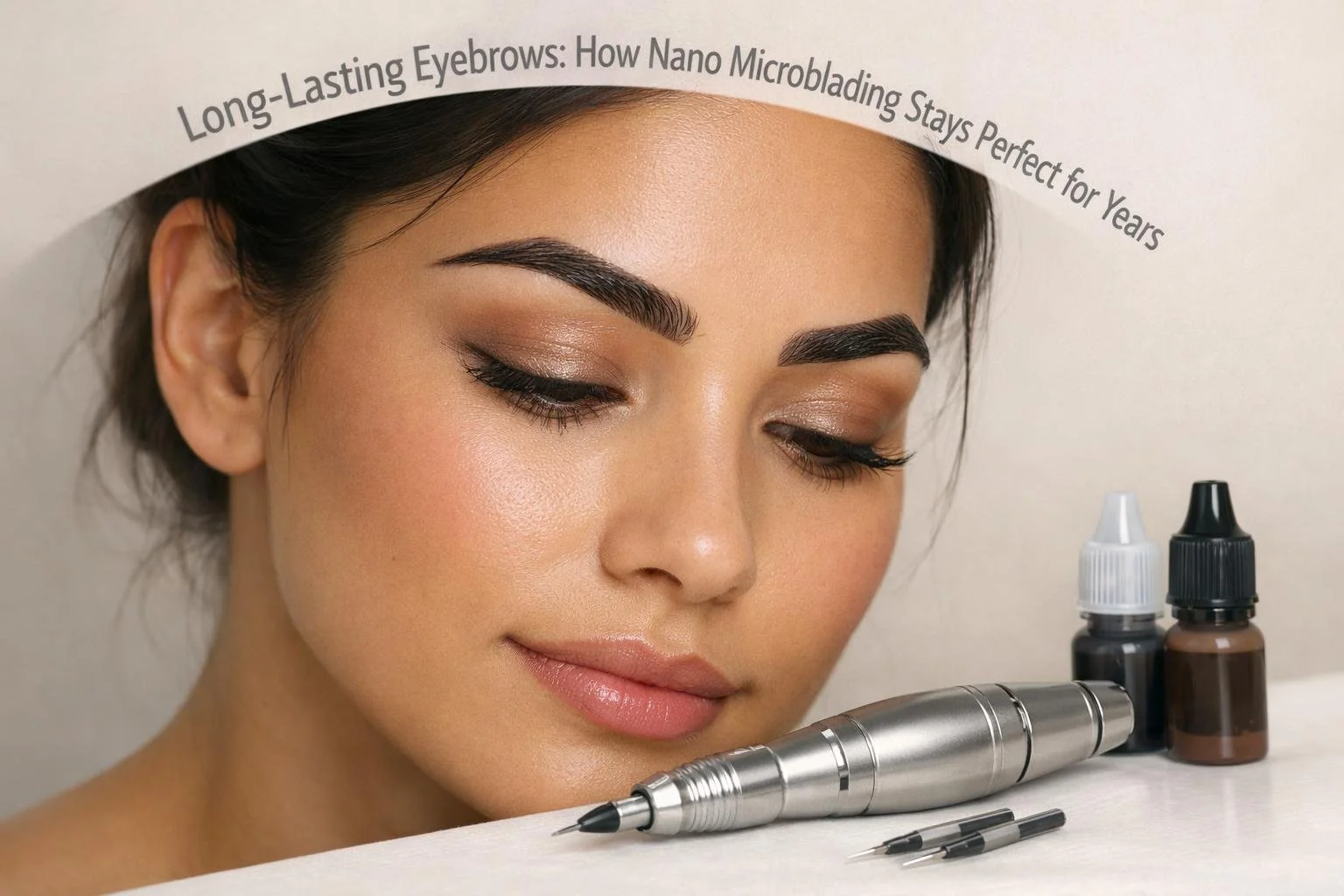
People always ask me the same thing after they've had the procedure and the healing is done and they're looking in the mirror for the first time at results that actually look like what they came in wanting.
They ask: "How long is this going to last?"
And I give them the honest answer, which is: it depends on five things you mostly control, one thing you partially control, and one thing that's just your skin doing what your skin does.
But before the "it depends" conversation, I want to address the version of the question nobody asks out loud but everyone is actually asking: "Is this going to look like my aunt's eyebrow tattoos from 1994 in ten years?"
No. It isn't. And understanding why it isn't — the actual mechanics of how modern nano microblading ages in skin compared to how older permanent makeup aged — is the most important thing I can tell you about longevity. Because once you understand why it fades the way it does, the maintenance conversation stops being a mystery and becomes a strategy.
Why Modern Nano Microblading Fades Differently Than the Eyebrow Tattoos You Remember
The 1990s eyebrow tattoo that turned slate blue-gray on your aunt's face was not a failure of semi-permanent makeup. It was the predictable result of the wrong ink, deposited at the wrong depth, applied with a machine built for body art, not for faces.
Traditional body tattoo ink contains heavy metal-based pigments — often cobalt for blue, chromium for green, cadmium compounds for yellow. These pigments are designed to be permanent. They sit in the deep dermis where the body can't easily metabolize them. Over decades, they migrate slightly and change how they reflect light, which is why old tattoos shift in tone. On a brow, where you're looking at a small area of face under close-range natural light, every color shift becomes visible.
Modern nano microblading uses iron oxide-based pigments specifically formulated for facial semi-permanent makeup. These are a fundamentally different chemistry. They're designed to fade — gradually, predictably, to lighter versions of themselves rather than to different colors. A warm brown fades to a lighter warm brown. A cool taupe fades to a softer taupe. They don't turn gray. They don't turn blue. They don't develop green undertones as they age. When quality pigments are selected and blended correctly for the individual client's skin tone, the fading process is invisible to most people — you just notice at some point that your brows are lighter than they used to be.
The machine nano technique adds another layer of predictability here. Because the needle depth is mechanically controlled rather than hand-guided, the pigment enters the skin at a consistent depth — consistently in the upper dermis, where semi-permanent pigment belongs. Too shallow, and it sits in the epidermis and gets pushed out entirely as the skin naturally exfoliates, giving you brows that disappear within weeks. Too deep, and you're in territory where pigment can migrate, where iron oxides can reduce and shift color, where the fade becomes less predictable. Consistent, correct depth is what makes the multi-year longevity of well-executed nano microblading possible.
This is also why pigment selection matters as much as technique. I custom blend for almost every client — two or three pigments mixed to match both the hair color and the skin undertone, accounting for the warming that happens as any pigment oxidizes during healing. A single pigment that looks perfect in the cap can heal to something slightly different on skin. A custom blend that accounts for your specific coloring and your skin's chemistry heals predictably and fades predictably. It takes longer in session. Clients don't see me doing it. But they see it in the results a year later when the color has softened gracefully instead of shifting.
The Five Factors That Determine How Long Your Nano Brows Actually Last
There's a version of the longevity conversation that goes: "nano microblading lasts 18 to 24 months." That's true in the same way "a car gets 30 miles per gallon" is true — accurate on average, meaningless without knowing how you drive.
Here are the five factors that actually determine where your results land in that range.
Factor one: Your skin type. This is the biggest variable and the one you have the least control over. Dry skin with tight pores holds pigment exceptionally well — the skin doesn't produce the oil that breaks down pigment over time, and the smaller pore structure means the healed strokes maintain crisp edges longer. Some of my dry-skin clients are at 22 months with nano brows that still look clear and defined. Oily skin is a different story. Sebum is not the enemy — it's just oil — but it does accelerate the breakdown of pigment at the skin surface over time. Nano machine strokes hold better on oily skin than traditional microblading because the mechanically consistent depth means the pigment is better anchored, but the oil still does its work. Oily-skin clients typically sit toward the 14 to 16 month end of the range before needing a refresh.
Factor two: UV exposure. UV radiation breaks down iron oxide pigments the same way it breaks down the color in fabric left in the sun — gradually but relentlessly. This is the factor that matters most in South Florida, where our UV index is elevated year-round and many clients spend real time outdoors. I tell every client the same thing at their six-week healed check-in: SPF on your brows, daily, from now until your next touch-up. Not just on beach days. Every day. Broad-spectrum SPF 30 or higher. Clients who follow this consistently go six to eight months longer between maintenance than clients who are casual about it. That's not a small difference — that's the difference between a 14-month touch-up and a 21-month touch-up.
Factor three: Your skincare routine. Retinol, tretinoin, glycolic acid, salicylic acid, vitamin C — these are excellent ingredients that accelerate skin cell turnover and exfoliate at the surface. They're also, directly on the brow area, a reliable way to fade your nano microblading faster than it needs to. These products don't know the difference between dead cells you want to shed and pigment you want to keep. The rule is simple: active exfoliants on the rest of your face, but avoid direct application on the brow area. You can still use your retinol. Just work around the brow. Same goes for professional treatments — if you're getting a chemical peel or a laser resurfacing treatment, tell your provider you have permanent makeup and ask them to protect the brow area.
Factor four: Your lifestyle. Regular pool swimming means regular chlorine exposure, which is an oxidizing agent that accelerates fading. Daily intense outdoor workouts mean daily sweat exposure and daily UV exposure. Hot yoga four times a week is not the same as running errands. I'm not telling anyone to change their lifestyle — that's not the point of the conversation. The point is that clients who live in their bodies in South Florida's climate need to plan their maintenance timeline accordingly, and they need to take the aftercare rules more seriously than someone who works in an office and swims twice a year.
Factor five: Pigment quality and application depth. This one is about the work itself, not the client's behavior. Pigment placed at incorrect depth — too shallow — fades dramatically fast, sometimes within weeks. Budget pigments that use fillers or lower-quality iron oxide formulations don't hold as long or fade as predictably. This is the variable you control by choosing your artist carefully, looking at actual healed portfolio work at 12 and 18 months post-procedure rather than just fresh-session photos, and having a real conversation about what pigments are being used and why.
The partial-control factor: hormones. Pregnancy, breastfeeding, hormonal medications, and significant hormonal shifts during perimenopause all affect how skin behaves and how pigment retains. Some clients find their nano brows hold beautifully for years and then fade faster during a hormonal transition. Some find the opposite. I can't predict it, and neither can they, but I can tell them to mention any significant hormonal changes at their next touch-up appointment so we can adjust the maintenance plan.
What "Years" Actually Looks Like — Month by Month
When I say nano microblading can stay looking good for two-plus years, I want to be specific about what that means at each stage. Because "looking good" at month two and "looking good" at month twenty are not identical — and clients who don't know that can mistake normal graceful fading for something going wrong.
Months one through six: This is the freshest phase. After the six-week healing is complete and the touch-up is done, your brows are at their most defined. The strokes are clear, the color is saturated (but not dark — healed nano brows settle into a natural color, not a bold one), and the overall shape is precise. People notice your brows in the way you want them noticed — not as something that looks done, but as something that looks like you just have good brows.
Months six through twelve: The color begins softening. This is normal, expected, and shouldn't alarm anyone. The strokes are still clearly individual and defined — nano machine strokes age cleanly, without the edge-blurring that traditional microblading can develop on oily skin. You might reach for a brow pencil once in a while for an event or a photo. Most clients are not doing daily brow makeup. The shape holds. The texture holds. What changes is color saturation.
Months twelve through eighteen: Depending on your skin type and lifestyle, this is when most clients notice the brows starting to look lighter than they'd like as a permanent state. Not bad — lighter. Some clients at this stage still look great and push to twenty months. Others schedule their refresh at fourteen months because their skin type moves faster. This is also when the quality of the original pigment selection becomes most visible — well-chosen iron oxides that faded to lighter versions of themselves look clean and soft; lower-quality pigments that have shifted undertone start showing their age more obviously.
Months eighteen through twenty-four: Refresh territory for most clients. The strokes are still there, usually — nano microblading doesn't disappear suddenly. It fades gradually and gracefully until you decide you want it darker again. Coming in for a maintenance touch-up at this stage is much simpler than the original procedure: we're refreshing existing work, not rebuilding from scratch. The appointment is shorter, the healing is typically smoother because your skin has been through this before, and the cost is less than the initial session.
Beyond two years: Some clients — particularly those with dry skin who are diligent about SPF — maintain excellent results past 24 months. I've seen clients at 28 months with nano brows that still read cleanly and don't need attention yet. Eventually everyone comes back. But "eventually" varies, and giving yourself the best conditions means it varies in your favor.
The Maintenance Appointments That Keep Everything Looking Right
I want to talk about touch-ups differently than most people in the industry do — because I think they get framed as a cost center when they're actually a quality tool.
The six-to-eight-week touch-up after your initial procedure is not optional maintenance. It's the second half of the procedure itself. Skin is unpredictable — different areas of the brow accept pigment differently, healing can be uneven in ways you can't always control, and some strokes need reinforcement after the first healing cycle. The touch-up is where I see what your skin actually did with the initial work and respond precisely to what's there. It's where "good nano brows" become "exactly right nano brows."
The annual or biannual color refresh is different. By this point, we're working on healed, settled skin with existing pigment that has simply lightened over time. The appointment is typically 60 to 75 minutes — significantly less than the initial two-to-three-hour session. We're going over the existing strokes to deepen color, adding new strokes only in areas where significant fading has occurred, and making any minor shape adjustments that reflect how your face may have changed or your preferences have evolved. Most clients leave looking the way they did about six months post-initial procedure — defined, natural, fresh.
One thing I've noticed: clients who come in for their refresh at 16 to 18 months, before the brows have faded significantly, have easier appointments and better outcomes than clients who push to 28 months and come in with very light, partially present strokes. There's a reason I say "refresh existing pigment" — you can work with what's there. When it's mostly gone, you're closer to starting over, and the appointment takes longer and costs more accordingly. Don't wait until you're back to filling in your brows daily before you call.
What You Do at Home That Either Extends or Shortens Your Results
I'm going to be direct about this because I've seen beautiful nano microblading that lasted fourteen months on a client who spent every afternoon in the sun and used glycolic toner directly on her brow area, and I've seen the same quality work on a similar skin type last twenty-six months on a client who treated aftercare like a discipline.
The rules aren't complicated. They're just consistently important.
SPF is not optional in South Florida. I've said this before and I'll say it in every article I ever write about permanent makeup because it's the single highest-impact thing clients can do for longevity. A broad-spectrum SPF 30 or higher, applied to your face every morning including your brow area, reapplied if you're outdoors. Clients who are serious about this push their maintenance appointments back by months. Clients who "usually wear it" push them back by weeks. The difference compounds over two years.
Keep acids and retinoids off the brow area. This doesn't mean stop using your skincare routine. It means apply your retinol, glycolic acid, and AHA products while avoiding the brow zone. An inch of clearance around the brow. It takes about five seconds of extra attention. It's worth it.
Gentle cleansers on the face. Harsh detergent cleansers and oil-based makeup removers that get worked directly over the brow area accelerate surface exfoliation. You don't need to change your entire cleanser — just be mindful of not vigorously scrubbing the brow area during cleansing.
Tell your dermatologist or esthetician. If you're getting a chemical peel, a laser treatment, an IPL session, or any professional skin treatment, tell your provider you have permanent makeup. Ask them to protect the brow area. Most providers know to do this when told — they just need to know.
Chlorine and extended outdoor swims. After the healing period, swimming is fine. But regular lap swimming in chlorinated pools does accelerate fading over time. You don't have to stop — just factor it into your touch-up timeline and be more consistent about SPF.
None of this is hardship. It's the agreement you make with the work — show up for it a little, and it shows up for you considerably.
The Long View: What Nano Microblading Looks Like as a Two-Year Relationship
I've been thinking about how to frame the longevity conversation and I keep coming back to this: nano microblading isn't a one-time purchase. It's an ongoing relationship with your face.
The initial procedure establishes the architecture — shape, design, technique. The touch-up refines it. The maintenance refreshes it. And each time you come back, you're not just getting darker strokes. You're having a conversation about whether the shape still works for your face, whether the color still fits where you are now, whether anything about your preferences or your lifestyle has changed that should influence the work. Faces change. Preferences evolve. Good permanent makeup evolves with them.
What I love about working with clients over years instead of single sessions is that we get genuinely good at reading each other. I know which of my long-term Boca Raton clients needs a touch-up at sixteen months without fail and which one I won't see until twenty-two. I know whose lifestyle is harder on the pigment and whose skin holds it like it's made for it. That knowledge makes every maintenance appointment faster, better, and more accurate than working with someone for the first time.
The real longevity of nano microblading isn't just how long a single session of pigment holds. It's how long you maintain a face that looks like you chose it — because you're tending to it the way things worth keeping deserve to be tended.
Book your free consultation at heragencyusa.com or reach me at Tknatalia1974@gmail.com — whether you're starting fresh or coming back for a refresh, I'm at Phenix Salon Suites, 7112 Beracasa Way, Suite 119, Boca Raton.
Frequently Asked Questions: Nano Microblading Longevity and Long-Term Results
Q1: How long does nano microblading last?
Most clients see excellent nano microblading results for 18 to 24 months, with some dry-skin clients maintaining clean definition for up to 26 to 28 months when diligent about SPF and skincare. The range is real — skin type is the biggest variable, with dry skin holding pigment significantly longer than oily skin. In South Florida specifically, factors like year-round UV exposure, humidity, and active outdoor lifestyles mean clients often sit toward the lower end of the range compared to counterparts in drier, cooler climates. Nano machine strokes consistently outlast traditional microblading by several months on the same skin type because the mechanically controlled depth creates more stable pigment retention. After the initial healed result settles at six weeks, the results hold their definition well through the first year, then gradually soften toward the 18 to 24 month window when most clients schedule a color refresh.
Q2: What makes nano microblading last longer than traditional microblading?
The durability advantage comes from two interrelated factors: consistent pigment depth and reduced skin trauma. Traditional manual microblading relies on the artist's hand pressure to control how deeply the blade cuts into the skin — even the most skilled hands produce some variation across a session. On oily or mature skin, this variation means some strokes hold crisply while others blur at the edges as the skin heals. A digital machine controls the needle oscillation depth mechanically, hitting the same target with every stroke across the entire brow. The result is uniform pigment deposit that ages more evenly and maintains hair-stroke definition longer between touch-ups. The machine's finer needle also creates less surface trauma, which means a more controlled healing process and less risk of the skin's repair response pushing pigment out unevenly during the critical first weeks.
Q3: How often do you need touch-ups for nano microblading?
There are two types of touch-up appointments. The first is the essential six-to-eight-week session after your initial procedure — this is the second half of the procedure itself, where the artist sees how your skin healed and refines the result accordingly. This is not optional maintenance; it's how the work is completed. The second type is the annual or biannual color refresh, typically needed somewhere between 16 and 24 months depending on your skin type, lifestyle, and SPF habits. Clients who come in for their refresh before the brows have faded significantly — around 16 to 18 months — have smoother, faster appointments. Clients who wait until 26 months with very light brows are closer to starting over, which takes longer and costs more. The maintenance rhythm is not burdensome — most clients settle into a once-yearly or once-every-eighteen-months pattern that keeps results looking fresh indefinitely.
Q4: Does nano microblading fade gracefully — or does it look bad as it ages?
With quality iron oxide pigments selected and blended correctly for the individual client's skin tone, nano microblading fades to lighter versions of itself rather than shifting to different or unflattering colors. A warm brown becomes a soft warm brown. A cool taupe becomes a lighter taupe. The strokes become less saturated but maintain their individual definition — particularly with nano machine strokes, which age cleanly without the edge-blurring that traditional microblading can develop on oily skin over time. The 1990s problem of eyebrow tattoos turning slate blue or gray was a function of the wrong inks at the wrong depth — modern facial pigments don't behave that way. What you'll notice as your nano brows age is that they look lighter and softer, not different in color or shape. That's the signal to book a refresh, not a sign that something went wrong.
Q5: What can I do to make my nano microblading last longer?
The five highest-impact habits for extending nano microblading longevity: daily broad-spectrum SPF 30 or higher on the brow area (UV exposure is the primary accelerator of fading — clients diligent about this go six to eight months longer between touch-ups); keeping exfoliating acids and retinoids away from the brow area while using them on the rest of the face; using gentle, non-abrasive cleansers over the brow area; informing dermatologists and estheticians about your permanent makeup before chemical peels, laser treatments, or IPL sessions so they can protect the brow zone; and scheduling your color refresh before the brows have faded significantly rather than waiting until they're nearly gone. In South Florida specifically, additional reapplication of SPF throughout the day for outdoor activities, plus protective hats, adds meaningful months to your results. None of these are major lifestyle changes — they're small, consistent habits that compound.
Q6: Can nano microblading last 3 years?
Some clients — typically those with dry to normal skin, consistent SPF habits, and lifestyles that don't involve heavy UV exposure, regular pool swimming, or daily intense outdoor activity — do maintain good results at or near the three-year mark. In South Florida's climate, reaching three years is less common than in drier or cooler regions, because our UV intensity and the lifestyle factors that come with coastal Florida living accelerate fading for everyone to some degree. What "lasting three years" means in practice is usually that the brows are still present and defined, but lighter than the client would like them to be as a permanent state — so they schedule a refresh rather than a full redo. With proper maintenance, nano microblading results can be maintained indefinitely; the three-year question is really asking how frequently refreshes are needed, which varies by individual.
Q7: Does nano microblading last longer on dry skin vs oily skin?
Yes — this is the most consistent difference in longevity I observe across client types. Dry skin with tight pores holds nano microblading pigment significantly longer, often reaching 22 to 26 months between refreshes with good SPF habits. Oily skin accelerates pigment breakdown at the skin surface through sebum production — even with nano machine strokes, which hold better than traditional microblading on oily skin, most oily-skin clients are in the 14 to 18 month range before needing a refresh. The machine technique's advantage is that the mechanically consistent depth creates better-anchored pigment that resists sebum breakdown more effectively than manual strokes — so oily-skin clients get better longevity with nano than with traditional microblading, just not as long as dry-skin clients will. If you have very oily skin and longevity is your primary concern, powder brows or combo brows may offer even better long-term retention than any hair-stroke technique.
Q8: What happens if you don't get a nano microblading touch-up — does it just fade completely?
Yes, eventually — but the process is gradual and leaves no permanent damage. Nano microblading with quality iron oxide pigments fades from full saturation to lighter and lighter versions of itself over a period of two to four years without touch-ups, eventually becoming barely visible. The skin is not permanently changed; the pigment is designed to be metabolized by the body over time. Many clients who skip a scheduled refresh find themselves back at daily brow maintenance within two years. Some decide at that point they want to let it fade completely and stop; some return for a new procedure. Neither outcome causes a problem with the skin. What I discourage is waiting so long that significant fading has occurred before coming back in — refreshing well-established pigment is a different procedure than rebuilding from near-zero, and the results of the refresh are better when there's existing work to build on.
Q9: How does SPF protect nano microblading — and what kind should I use?
UV radiation breaks down the iron oxide pigments in nano microblading the way sunlight breaks down color in any material — gradually but consistently, with cumulative effect over time. In South Florida's UV environment, unprotected brows can fade noticeably faster than in other regions. A broad-spectrum SPF 30 or higher, applied daily to the face including the brow area, significantly slows this process. Reapplication matters for outdoor exposure. The type of SPF matters less than the habit — mineral, chemical, or hybrid formulas all provide protection when applied correctly. What to avoid: tanning beds entirely (the concentrated UV exposure is severe for permanent makeup longevity), and SPF sprays that aren't rubbed in thoroughly, which can leave gaps in protection. The SPF habit is the single highest-return action for longevity — clients who are serious about it regularly extend their maintenance interval by six to eight months compared to clients who are casual about sun protection.
Q10: Where can I get long-lasting nano microblading in Boca Raton?
Her Agency is located at Phenix Salon Suites, 7112 Beracasa Way, Suite 119, Boca Raton, FL 33433, serving clients throughout South Florida including Delray Beach, Coral Springs, Coconut Creek, Parkland, Pompano Beach, and Fort Lauderdale. When researching nano microblading studios near you, look for healed portfolio work shown at 12 to 18 months post-procedure — not just fresh-session photos, which always look their most saturated immediately after the appointment. Ask specifically about the pigments used and how color selection is customized for your skin tone. A quality artist will spend significant time on pigment blending during your session and should be willing to explain the reasoning. Complimentary consultations are available at heragencyusa.com — this is where we assess your skin type, discuss your lifestyle, and determine which technique will give you the most durable results for your specific situation.
