
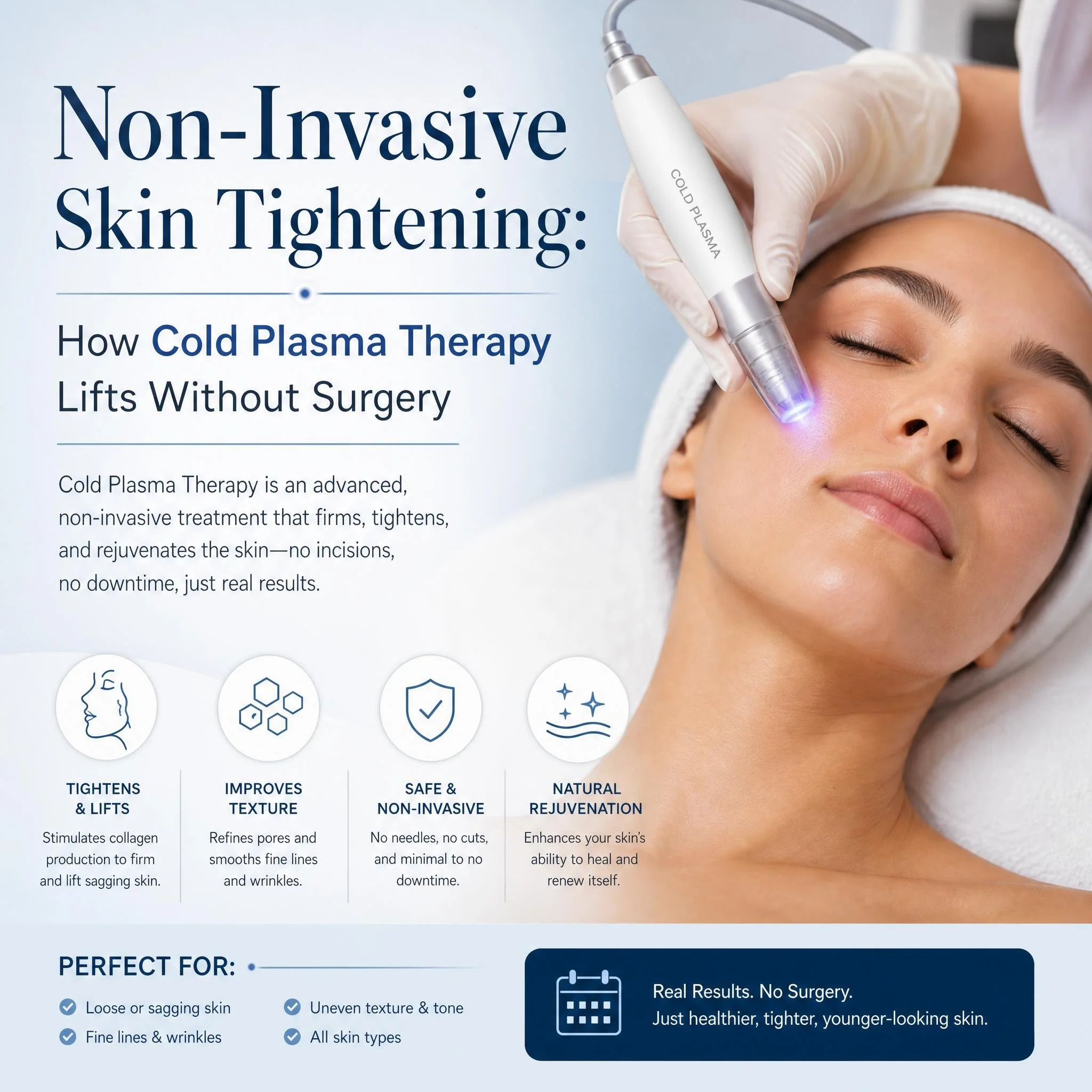
Non-Invasive Skin Tightening: How Cold Plasma Therapy Lifts Without Surgery
Before we go any further, I need to make a distinction that the aesthetic industry almost never makes clearly — and that omission creates real confusion for clients trying to understand what they're booking.
There are two fundamentally different treatments that both go by variations of the word "plasma" in professional skincare. They work through different mechanisms, produce different results at different timelines, and carry different expectations. Presenting them as interchangeable — or using one's results to market the other — is one of the more persistent sources of client disappointment in aesthetic treatment.
Plasma fibroblasting (also called "plasma pen," "soft surgery," or "plasma lift") is a thermal treatment. A handheld device creates a controlled electrical arc that makes direct contact with the skin, causing immediate tissue sublimation — the skin surface contracts and creates small carbon crusts. The immediate physical contraction of tissue is visible. The results are dramatic. The downtime involves scabbing, significant redness, and several days of visible healing. For eyelid tightening, jowl reduction, and significant laxity, this treatment produces real results — results that have earned it the "soft surgery" description because the outcome can approach what surgical blepharoplasty achieves for appropriate candidates.
Cold atmospheric plasma (CAP) — which is what I offer at my studio at Phenix Salon Suites in Boca Raton — is non-thermal. No electrical arc on the skin. No controlled burning. No carbon crusts. No scabbing. The device passes approximately one centimeter from the skin surface, delivering a stream of reactive oxygen and nitrogen species that interact with skin cells through chemistry rather than heat, triggering collagen synthesis, fibroblast activation, and elastin production over a treatment series.
Both treatments are genuinely non-surgical. The mechanisms are completely different. The results timeline is completely different. And the appropriate candidates are completely different.
If you came to this article looking for something close to a surgical blepharoplasty result without the surgery, that's plasma fibroblasting — and I'll tell you honestly what that treatment is and where to evaluate it. If you came looking for real, progressive skin tightening with zero downtime, zero recovery, and a mechanism that builds structural improvement through your skin's own biology, that's cold atmospheric plasma — and that's what I'll spend the rest of this article explaining properly.
What "Tightening" Through Cold Plasma Actually Means
Skin laxity — the looseness, softening, and loss of definition that most people associate with aging — has two primary structural causes.
The first is collagen loss. The dermis contains a dense network of collagen fibers that give skin its mechanical strength and resistance to deformation. As collagen production declines with age (beginning in the mid-twenties, accelerating through the forties and fifties) and as UV exposure fragments existing collagen through oxidative damage, the dermal matrix becomes thinner, weaker, and less able to maintain the skin surface in a firm position against the effects of gravity and repeated expression.
The second is elastin loss. Elastin fibers give skin its ability to spring back after deformation — the "snap" of young skin versus the slow recovery of aging skin. Like collagen, elastin production declines with age and UV damage, and the fibers that remain become disorganized and brittle.
Cold atmospheric plasma addresses both through a documented biological mechanism. <cite index="43-1">A significant increase in epidermal thickness, fibroblast proliferation, and skin collagenesis were discovered</cite> in CAP-treated tissue studies published in PMC. Research published in peer-reviewed dermatology literature confirms that cold atmospheric plasma activates dermal fibroblasts — the cells responsible for manufacturing both collagen and elastin — through the controlled signaling of reactive oxygen and nitrogen species at therapeutic concentrations.
Additionally, <cite index="35-1">low intensity cold atmospheric plasma reduces wrinkles on photoaged skin through hormetic induction of extracellular matrix protein expression in dermal fibroblasts</cite> — a finding that specifically links CAP to the wrinkle and laxity concern that clients are actually trying to address, not just general skin improvement.
The "hormetic induction" concept is worth explaining because it's central to why cold plasma tightening works at all. Hormesis is the biological phenomenon where a low-level stressor produces a beneficial adaptive response — the same principle behind exercise (controlled muscle stress producing strength) and vaccination (controlled immune challenge producing protection). Cold atmospheric plasma's ROS, at therapeutic concentrations, creates a controlled oxidative signal that the fibroblasts interpret as a challenge requiring an adaptive response: produce more collagen, produce more elastin, rebuild the extracellular matrix. The cells do exactly that, progressively, over the weeks following each treatment.
This is genuine tightening from structural improvement. It is not the immediate physical tissue contraction of thermal plasma fibroblasting. It is the slower, cumulative version — the type that produces results that look natural because they are natural, because the skin's own cells are doing the work.
What Cold Plasma Tightening Can and Cannot Do — The Honest Scope
I would be failing you if I let the "lifts without surgery" framing go unexamined, because it can imply more than non-thermal cold plasma specifically delivers.
What cold plasma tightening genuinely produces, with research support:
Progressive improvement in skin firmness as new collagen is synthesized in the treated dermis over a series of sessions. Clinical research documents 50% improvement in skin elasticity after eight sessions — this is structural improvement, measurable at the tissue level, not just a surface phenomenon.
Reduction in fine line and wrinkle appearance as the collagen matrix is rebuilt to better support the skin surface. The "wrinkles on photoaged skin" finding from CAP research reflects this mechanism directly.
Improvement in the overall quality and thickness of the dermis, which is the structural basis for skin that looks and feels more "solid" — less papery, less fragile, less visibly lax.
Improved skin tone and surface quality that makes the skin look more lifted not through actual tissue movement but through the way healthy, well-collagenated skin reflects light differently than thin, depleted skin.
What cold plasma tightening cannot produce:
Physical tissue contraction that immediately reduces the visible area of lax skin — that's the thermal plasma fibroblasting mechanism.
Correction of significant structural laxity — pronounced jowls, significant neck skin hanging, dramatically hooded eyelids — where the amount of excess skin would require either physical removal or aggressive contraction. For significant structural laxity, the options remain surgery, RF-based treatments (which use heat energy to produce tissue contraction at deeper levels), or HIFU/Ultherapy (which focuses ultrasound energy at the SMAS level for lifting of deeper tissues).
Replacement of lost volume — the hollowed cheeks, depleted under-eye area, or thinned lips that create a "sunken" aging appearance. That requires filler.
Cold plasma is genuinely tightening in the sense that it rebuilds structural collagen and elastin, which is the biological foundation of firmer skin. It is most appropriate for early to moderate laxity — skin that is softening, losing definition, feeling less resilient than it did — not for significant structural sagging where the skin has already moved considerably from its original position.
Comparing Cold Plasma to Other "Without Surgery" Tightening Options
The non-surgical tightening market includes several legitimate options that operate through genuinely different mechanisms, and an honest comparison helps place cold plasma appropriately rather than overselling or underselling it.
Radiofrequency (RF) skin tightening ($200–600 per session at Boca Raton clinics): RF uses heat energy generated by radiofrequency waves to cause thermal injury at controlled depth in the dermis, triggering a wound-healing response that includes collagen synthesis and collagen fiber contraction. RF produces immediate tissue tightening from the collagen contraction effect, plus longer-term collagen synthesis. For moderate skin laxity, RF is generally more immediately visible per session than cold plasma. The trade-off: RF carries burn risk if improperly calibrated, produces more post-treatment redness, and is generally more uncomfortable during the procedure. Cold plasma achieves collagen stimulation through the gentler chemistry mechanism without thermal risk or discomfort.
HIFU / Ultherapy ($600–2,000 per treatment): High-intensity focused ultrasound targets the SMAS layer — the structural muscle-fascia layer beneath the dermis that surgical facelifts address directly. This is the most invasive non-surgical approach for structural laxity, genuinely reaching depths (1.5 to 4.5 millimeters) that RF and cold plasma don't address. For significant jowling and neck laxity, HIFU can produce results that approach surgical correction for appropriate candidates. It is also considerably more uncomfortable during the procedure, carries risk of nerve pain in some cases, and costs several hundred to several thousand dollars per session. Cold plasma is in an entirely different category of intervention — it's not competing with HIFU for significant structural laxity, it's competing in the early-laxity maintenance and prevention space.
Thread lifts ($1,500–4,500): Dissolvable sutures placed under the skin through a needle to provide immediate mechanical lifting, which also stimulates collagen around the threads as they dissolve. This provides visible immediate lifting with a procedure that takes 30 to 60 minutes but involves needles under the skin, carries risk of thread migration or visibility, and requires a provider with appropriate training in the technique. Cold plasma doesn't compare to thread lifts for significant lifting — they're addressing different degrees of laxity.
Surgical facelift ($8,000–20,000): The benchmark against which all non-surgical options are compared and inevitably found wanting for significant structural aging. Surgery repositions tissue, removes excess skin, and produces results that no non-surgical approach fully replicates for advanced laxity. This is not a failure of non-surgical treatments — it's an honest acknowledgment that different degrees of the same condition require different scales of intervention.
Cold plasma ($150 standalone / $200 as part of combined treatment): The most accessible, lowest-risk, zero-downtime option for early to moderate laxity and skin quality improvement. Produces real structural collagen and elastin improvement over a series. Appropriate as a standalone for early concerns and lifestyle-compatible maintenance, and as a complement to more intensive treatments (RF, HIFU, surgical) for clients who want to maintain and extend results between more aggressive interventions.
The South Florida Laxity Pattern — Why Early Intervention Matters Here
The specific aging pattern I see consistently in Boca Raton clients involves skin that has been aging faster than chronological age would predict because of cumulative UV exposure — collagen fragmentation from oxidative damage, elastin degradation from photo-damage, and the general dermal thinning that South Florida's year-round high-intensity UV produces in skin that has been here for years.
This UV-accelerated laxity pattern responds well to the cold plasma mechanism specifically because the treatment directly addresses the fibroblast biology that UV damage has impaired. UV radiation not only damages the structural proteins (collagen and elastin) directly, but also impairs the cells that produce them — the dermal fibroblasts accumulate oxidative DNA damage from chronic UV exposure that reduces their functional collagen synthesis capacity over time. Cold plasma's controlled ROS signaling, through hormetic activation, works with the fibroblasts' own signaling pathways in a way that is specifically relevant for UV-damaged cells.
The argument for early intervention in South Florida is also practical: once significant structural laxity has developed, the range of appropriate non-surgical options narrows considerably toward more intensive, more expensive, and more invasive interventions. Cold plasma as a consistent maintenance treatment — monthly or bimonthly, as part of a broader skin care strategy — is most effective when it's maintaining skin that is in the early stages of laxity rather than trying to reverse laxity that has already progressed significantly.
A client in her mid-thirties noticing the first softening along her jawline and some reduction in facial skin resilience is an ideal cold plasma candidate — the intervention is proportionate to the concern, the mechanism is specifically suited to the biological stage of the aging process she's in, and consistent treatment through her forties can meaningfully slow the progression to the moderate laxity that would then require more intensive approaches.
The Treatment Sequence for Maximum Effect
Cold plasma for skin tightening produces better results when it's integrated into a thoughtful treatment plan rather than used in isolation.
The most effective sequence I've observed in practice combines cold plasma with the other treatments in the studio menu that address different aspects of the skin tightening concern:
With deep cleaning facials ($85): Monthly deep cleaning facials maintain the follicular clarity and skin surface that cold plasma's cellular signaling work needs to penetrate effectively. Congested, debris-laden skin receives the plasma's RONS differently than fresh, well-maintained skin.
With carboxy therapy ($55–65): The Bohr-effect oxygenation from carboxy therapy improves the metabolic environment in which cold plasma's fibroblast-activated collagen synthesis is occurring. Better oxygenated fibroblasts produce higher-quality, better-organized collagen than fibroblasts working in a relatively hypoxic tissue environment. The two treatments address the tightening concern from complementary vascular and cellular angles.
With PRP microneedling ($200): For clients with moderate laxity requiring the more intensive wound-healing cascade of microneedling, cold plasma sessions between PRP appointments maintain the cellular environment and support healing — and the combined collagen stimulus from both mechanisms produces more comprehensive dermal rebuilding than either treatment alone.
As the Frequency, Cold Plasma, Light combination ($200): The combined treatment sequences high-frequency therapy (circulation, antibacterial) → cold plasma (cellular collagen signaling, RONS) → LED light therapy (photobiomodulation, mitochondrial energy support for collagen synthesis). Each technology creates better conditions for the next, producing a collagen-stimulating session that is more comprehensive than cold plasma alone.
Realistic Expectations at Different Stages of Laxity
I want to give you something more specific than the generic "results vary" disclaimer that makes every treatment claim meaningless.
Early laxity (mid-30s to mid-40s, first signs): Skin that is beginning to soften along the jawline, losing some of the resilience that made it snap back easily, showing early texture changes that weren't there at 30. Cold plasma, at monthly intervals, produces visible maintenance of this early condition — skin that continues looking its age rather than progressively older, and that maintains better quality than untreated skin at the same age. For this client, cold plasma is the right scale of intervention, and it's the most accessible and lifestyle-compatible way to address the concern.
Moderate laxity (mid-40s to mid-50s, established but not severe): Visible softening along the jawline, some early jowling, neck skin beginning to show laxity, skin that is noticeably less firm than it was. Cold plasma produces real improvement here through its collagen synthesis mechanism — skin that looks and feels firmer over a series, with improvement that is visible to the client and often to others. This is the territory where combining cold plasma with PRP microneedling (for the more intensive collagen stimulus) and carboxy therapy (for vascular support) produces the most comprehensive result.
Significant laxity (advanced aging with substantial excess skin or tissue displacement): Pronounced jowls, significant neck skin, dramatically hooded eyelids, structural tissue that has moved considerably from its original position. Cold plasma will improve the skin quality in these areas — texture, tone, elastin resilience — but it will not move tissue back to its original structural position. This requires a conversation about more intensive options: HIFU for moderate cases, surgical consultation for advanced cases. I would rather tell a client this honestly during the consultation than book them for a series of cold plasma sessions for a concern it cannot adequately address.
The Low-Risk Case for Trying It
Everything about cold plasma therapy's profile — no needles, no downtime, no recovery period, no heat risk, no post-treatment restrictions, safe for all skin tones and types — removes almost every barrier that makes people hesitant about professional anti-aging treatment.
You don't need to clear your schedule. You don't need to hide from the sun for a week. You don't need to manage a healing process or explain your appearance to colleagues. You walk out of the session looking approximately the same as you walked in, and then over the following weeks your skin is progressively firmer, better textured, and more even because your fibroblasts are doing what the treatment told them to do.
The risk of trying cold plasma is minimal. The cost of a three-session assessment ($450) is well within the range of what most Boca Raton clients spend monthly on products that work at the surface while this treatment works in the dermis.
What I can't promise is that cold plasma will address everything you're concerned about. For significant structural laxity, it isn't the tool — and I'll tell you that at consultation rather than after you've completed a series. For early to moderate laxity, for progressive skin quality maintenance, for keeping ahead of the aging curve rather than trying to reverse significant progression — it is a genuinely effective, risk-appropriate, lifestyle-compatible tool that most clients in South Florida should know is available to them.
Standalone Cold Plasma Therapy for face and neck is $150. The combined Frequency, Cold Plasma, and Light Treatment is $200. Free consultations at heragencyusa.com — Phenix Salon Suites, 7112 Beracasa Way, Suite 119, Boca Raton. Serving Delray Beach, Coral Springs, Coconut Creek, Parkland, Pompano Beach, and across South Florida.
Frequently Asked Questions: Cold Plasma Therapy for Skin Tightening in Boca Raton
Q1: Can cold plasma therapy actually tighten skin — is the tightening real?
Yes, the tightening is real and structurally documented. Cold atmospheric plasma stimulates dermal fibroblasts through controlled reactive oxygen species signaling, producing increased collagen and elastin synthesis in the treated tissue. Peer-reviewed research published in PMC confirms significant increases in epidermal thickness, fibroblast proliferation, and collagenesis in CAP-treated skin. Additional research shows that low-intensity cold atmospheric plasma reduces wrinkles on photoaged skin through hormetic induction of extracellular matrix protein expression in dermal fibroblasts — specifically the collagen and elastin matrix that provides skin's structural firmness. Clinical research documents 50% improvement in skin elasticity after eight sessions, reflecting actual tissue-level structural improvement. The tightening from cold plasma builds progressively over a series as new collagen matures — it is not the immediate physical tissue contraction of thermal plasma treatments, but it is genuine structural improvement that becomes measurable and visible over the weeks and months following consistent treatment.
Q2: What is the difference between cold plasma skin tightening and plasma pen / plasma fibroblasting?
These are fundamentally different treatments that share only the word "plasma." Plasma fibroblasting (plasma pen, soft surgery) uses a thermal electrical arc that contacts or nearly contacts the skin to create controlled sublimation — micro-injuries that cause immediate physical tissue contraction and carbon crust formation. The immediate tissue contraction produces visible lifting results, but the treatment involves deliberate micro-burns, scabbing during healing, and several days of visible recovery. Cold atmospheric plasma (CAP) is non-thermal — the device passes approximately one centimeter from the skin without contact, delivering reactive oxygen and nitrogen species that interact with skin cells through chemistry rather than heat. There is no tissue contraction, no burning, no scabbing. Cold plasma produces tightening through progressive collagen and elastin synthesis over a treatment series — the biological improvement pathway rather than the physical contraction pathway. For significant immediate tissue contraction and lifting, plasma fibroblasting produces more dramatic per-session results. For zero-downtime progressive tightening appropriate for early to moderate laxity, cold atmospheric plasma is the more accessible, lower-risk option.
Q3: How many cold plasma sessions are needed for skin tightening results?
The research documenting 50% improvement in skin elasticity is based on eight sessions, and clinical improvement in facial rejuvenation studies shows meaningful improvement at four and twelve weeks. For skin tightening specifically, a series of six to eight sessions — spaced weekly or biweekly initially, then monthly for maintenance — produces the most significant cumulative collagen synthesis and visible firmness improvement. The timeline is progressive: each session adds to the collagen foundation built by previous sessions, with the most significant improvement visible two to three months after beginning a consistent series as the new collagen matures. Single sessions produce early-stage benefit including improved circulation and initial fibroblast activation, but the structural collagen improvement that produces visible tightening requires consistent treatment over multiple sessions. For early laxity, monthly maintenance sessions after an initial series can sustain and continue the improvement indefinitely.
Q4: Is cold plasma better than radiofrequency for skin tightening?
The two treatments are appropriate for different stages of laxity and produce tightening through different mechanisms. Radiofrequency uses heat energy to cause thermal tissue injury at controlled depth, triggering both immediate collagen fiber contraction (producing visible same-session tightening) and longer-term collagen synthesis from the wound-healing response. RF generally produces more immediately visible tightening per session for moderate laxity. Cold plasma produces tightening through non-thermal cellular signaling — no heat, no discomfort, no risk of burns — with progressive collagen improvement over a series. Cold plasma has superior tolerability, no downtime, and safety for all skin tones including darker complexions where RF's heat energy carries hyperpigmentation risk. For early laxity and lifestyle-compatible maintenance, cold plasma is the more appropriate choice. For moderate to significant laxity where more immediate visible improvement is needed, RF may produce faster tightening results. Many clients use both — RF periodically for the more intensive tightening response, cold plasma monthly for consistent maintenance and the non-thermal collagen stimulation that RF doesn't provide.
Q5: Can cold plasma tighten neck skin specifically?
Yes, and the neck is one of the areas where cold plasma's mechanism is particularly relevant. Neck skin is thinner than facial skin with fewer sebaceous glands, making it more susceptible to both UV-driven collagen loss and laxity-related changes. The cold plasma treatment for the neck follows the same fibroblast activation mechanism as facial treatment, stimulating new collagen production in the neck's thinner dermis to progressively improve firmness and texture. Because neck skin heals somewhat differently than facial skin and has different underlying structural support, the tightening results on the neck from cold plasma are gradual and best maintained with consistent treatment. For early to moderate neck laxity — skin that is becoming less resilient, beginning to show horizontal lines, losing some definition at the jawline — cold plasma is a reasonable maintenance approach. For significant neck sagging where the skin has substantially displaced from its original position, more intensive options (HIFU for moderate cases, surgical consultation for advanced cases) should be discussed.
Q6: How does cold plasma tightening compare to HIFU / Ultherapy?
HIFU (high-intensity focused ultrasound) focuses ultrasound energy at depths of 1.5 to 4.5 millimeters in the skin and SMAS layer — the muscle-fascia layer that surgical facelifts address directly. This depth access allows HIFU to produce more significant structural lifting for moderate to significant laxity than surface or dermal-level treatments can achieve. HIFU typically costs $600 to $2,000 per session, is more uncomfortable during the procedure, and carries some risk of nerve pain or uneven results in certain facial areas. Cold plasma works at the dermal level through non-thermal cellular chemistry, producing progressive collagen and elastin improvement without reaching the deeper structural layer that HIFU targets. For significant jowling, substantial neck laxity, or structural aging that has progressed beyond early-moderate stages, HIFU addresses depths and structures that cold plasma doesn't reach. For early to moderate laxity, consistent cold plasma maintenance may achieve comparable results to infrequent HIFU treatments at a fraction of the per-session cost, with zero discomfort and no recovery. For clients with both early laxity and a desire for the most comprehensive non-surgical approach, combining regular cold plasma with annual HIFU addresses both the cellular maintenance and the structural lifting dimensions.
Q7: Is cold plasma skin tightening safe for all skin types including darker skin tones?
Cold plasma tightening is specifically notable for its safety profile across all Fitzpatrick skin types. The treatment operates through ROS and RNS chemistry at near body temperature — no heat generation that could trigger post-inflammatory hyperpigmentation in melanin-rich skin, no high-intensity light that requires melanin-specific calibration. For South Florida's diverse population, which includes clients across the full range of skin tones from Fitzpatrick I through VI, cold plasma provides skin tightening and collagen stimulation benefits without the hyperpigmentation risk that heat-based tightening treatments (RF, thermal plasma, laser resurfacing) carry for darker complexions. This is a specific clinical advantage over several popular alternatives in the tightening category.
Q8: What areas can cold plasma tightening treat besides the face?
Cold plasma tightening can be applied to any area of the face and neck covered in the treatment session. Common areas of focus include the jawline and lower face where early jowling begins; the perioral area and marionette lines; the cheeks where collagen loss first becomes visible as changing contour; and the neck where horizontal lines and early laxity respond to progressive collagen stimulation. The combined Frequency, Cold Plasma, and Light Treatment at Her Agency covers full face and neck. For décolletage and hands — both areas prone to laxity from thin skin and UV exposure in South Florida — these can be discussed during consultation for inclusion in a broader treatment plan. The plasma delivery mechanism works on any skin surface where the device can be appropriately positioned.
Q9: How does cold plasma skin tightening feel — is there any downtime?
Cold plasma tightening has no downtime. The sensation during treatment is mild intermittent tingling — similar to light static electricity — as the plasma stream passes near the skin. Most clients describe it as comfortable, some as pleasant. There is no heat sensation, no physical contact with the skin, and no discomfort. Post-treatment, clients return immediately to any normal activity including makeup application, outdoor activity, and professional obligations. Some temporary mild redness may occur and resolves within a few hours. There are no restrictions on activity, sun exposure, or products following the treatment beyond the ongoing SPF habit that benefits all South Florida skin regardless of treatment status. This makes cold plasma tightening uniquely compatible with the active, social, outdoor-oriented lifestyle of Boca Raton clients who cannot afford the recovery time that more intensive tightening treatments require.
Q10: Where can I get cold plasma skin tightening near me in Boca Raton?
Her Agency at Phenix Salon Suites, 7112 Beracasa Way, Suite 119, Boca Raton, FL 33433 offers Cold Plasma Therapy for face and neck at $150, and the combined Frequency, Cold Plasma, and Light Treatment at $200. Consultations are free and include an honest assessment of the degree of laxity present and whether cold plasma is the appropriate treatment scale — or whether the concern warrants discussing more intensive options including RF, HIFU, or surgical consultation. The consultation will not result in a booking if the treatment isn't right for your specific anatomy and concerns. Services are available to clients throughout South Florida: Delray Beach, Coral Springs, Coconut Creek, Parkland, Pompano Beach, Deerfield Beach, and Fort Lauderdale. Bookings and consultations at heragencyusa.com. When researching cold plasma skin tightening near you, ask specifically whether the provider is offering cold atmospheric plasma (non-thermal) or plasma fibroblasting (thermal arc) — these are different treatments with different mechanisms, results timelines, and recovery requirements, and the distinction matters significantly for setting accurate expectations.
