
I get this question often enough that I want to answer it properly instead of giving the vague "it depends on your skin" non-answer that doesn't actually help anyone decide.
Here's the honest, specific version: for some concerns, the research shows these two treatments produce statistically equivalent results, and the choice comes down to your tolerance for needles and downtime. For other concerns, one treatment has a documented advantage over the other. And for some clients, the best answer isn't either treatment alone — it's both, used for what each does best.
What I won't do is tell you one treatment is universally superior, because the actual split-face clinical trials comparing them directly don't support that conclusion. They support something more useful: a concern-by-concern breakdown of where each treatment wins, ties, or loses.
How the Two Treatments Actually Work — The Mechanism Difference
Before comparing outcomes, it's worth being precise about why these treatments produce collagen synthesis through completely different biological pathways, because that difference explains why the results split the way they do across different skin concerns.
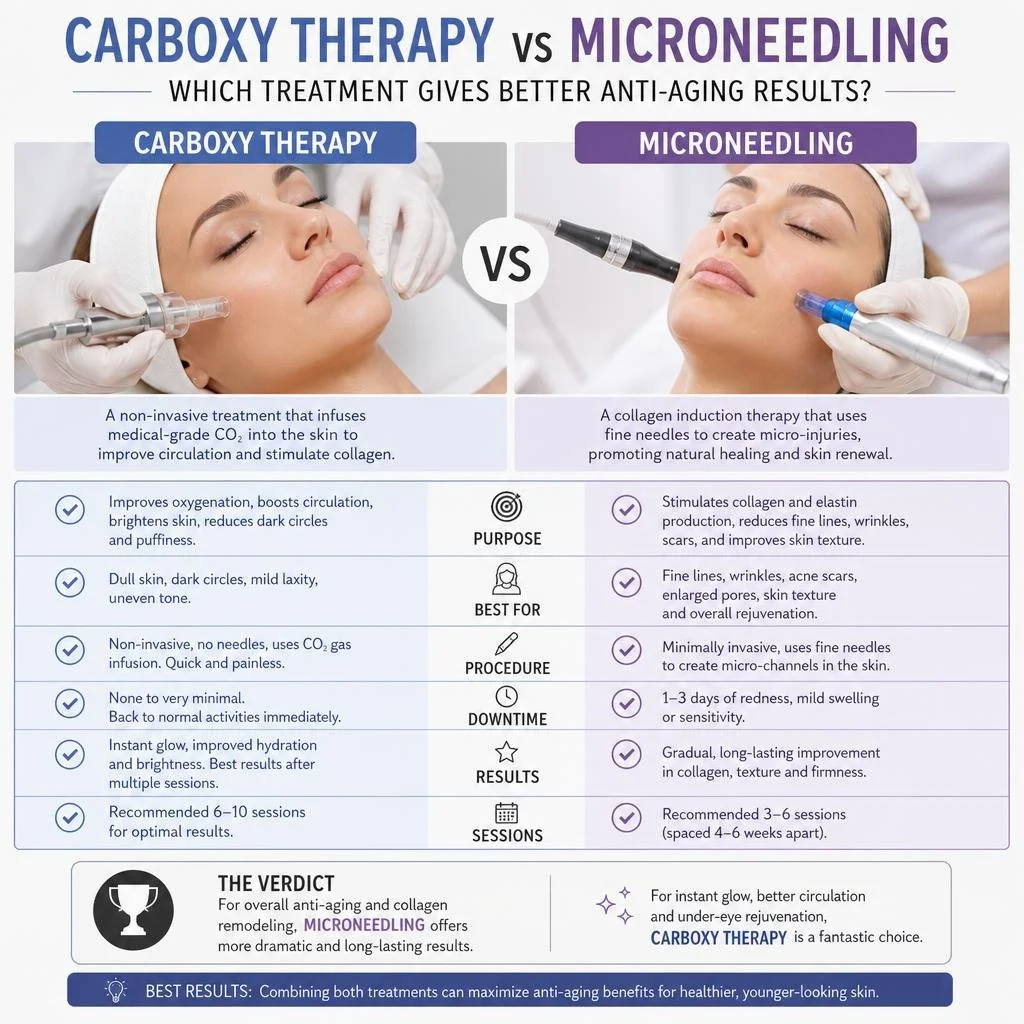
Microneedling creates controlled physical injury. A device with fine sterile needles punctures the skin at calibrated depth, creating thousands of microscopic wounds. The body responds to this injury the way it responds to any wound: inflammatory cells arrive, growth factors are released, fibroblasts are activated, and new collagen and elastin are synthesized to repair the damage. Research published in a 2024 narrative review identified the primary physiological mechanisms of microneedling as collagen and elastin production, angiogenesis (new blood vessel formation — a mechanism it shares with carboxy therapy, through a different trigger), transient increases in skin permeability, and improved epidermal barrier function following treatment. The mechanical injury is also what allows microneedling to physically disrupt fibrous scar tissue — the tethering bands that hold depressed acne scars down — which is central to why it works as well as it does for atrophic scarring.
Carboxy therapy introduces no physical injury at all. CO2 delivered to the skin reacts with plasma water to form carbonic acid, lowering local tissue pH. This pH shift triggers the Bohr effect — hemoglobin releases oxygen more readily under more acidic conditions — producing vasodilation, increased blood flow, and oxygenation of the dermal tissue. Over a treatment series, this drives neoangiogenesis (new capillary growth via VEGF stimulation) and increased fibroblast activity from the improved oxygen and nutrient supply. No wound is created. No tissue is mechanically disrupted. The collagen synthesis that results comes from improved metabolic conditions for the fibroblasts already present, not from a healing response to injury.
This distinction — mechanical injury versus chemical/vascular signal — is the reason the two treatments perform differently depending on what specific problem you're trying to solve.
What the Direct Comparison Studies Actually Found
This is the part of the conversation most articles skip, because head-to-head clinical trials comparing carboxytherapy and microneedling directly are rare enough that most sources default to generalities. A few exist, and they're worth walking through specifically.
For atrophic acne scars: a tie. A split-face clinical trial published in Dermatologic Surgery treated 32 patients with atrophic acne scars — microneedling on one side of the face, carboxytherapy on the other, six sessions each. The results: both treatments produced a statistically significant reduction in total acne scars and in each scar subtype (ice pick, boxcar, and rolling) individually (p ≤ .001). When the two sides were compared directly against each other, there was no statistically significant difference in outcome (p > .05). Histopathological analysis — actual tissue biopsy comparison — found improved collagen and elastic fiber organization and increased epidermal thickness on both sides, again with no significant difference between the two treatments. The study's conclusion was direct: both carboxytherapy and microneedling are equally effective, tolerable, safe, and noninvasive treatments for atrophic acne scars.
This is a genuinely useful finding because it means the choice for acne scarring specifically can be made on factors other than efficacy — needle tolerance, downtime preference, and cost, since the outcomes are statistically equivalent.
For periorbital hyperpigmentation (dark circles from pigmentation): carboxy therapy wins. A split-face pilot trial published in a peer-reviewed dermatology journal compared carboxytherapy injection on one side of the periorbital area against microneedling combined with topical glutathione on the other side, across 31 female patients over six biweekly sessions. The result: microneedling with topical glutathione showed less improvement of periorbital hyperpigmentation compared to carboxytherapy. The researchers noted that carboxytherapy's vascular mechanism — increased blood flow and the growth factor cascade triggered by the oxygen deficit signal, including VEGF for new blood vessel formation — appears more directly suited to the specific pathology of periorbital hyperpigmentation, which has a significant vascular component in addition to pigmentation.
For stretch marks: comparable, with nuance. Comparing carboxytherapy to pulsed dye laser (a different comparison than microneedling specifically, but relevant context) found no significant difference in overall scar improvement scores between the two modalities — but pulsed dye laser produced better improvement in skin pliability/texture, while carboxytherapy and the laser performed comparably on the pigmentation component. This pattern — different treatments excelling at different specific aspects of the same overall condition — recurs across the comparison literature and is the central honest takeaway: "better" depends on which specific quality of the skin concern you're prioritizing.
Why Carboxy Wins for Vascular and Pigmentary Concerns
The periorbital hyperpigmentation study result isn't an isolated finding — it reflects something structurally true about carboxy therapy's mechanism that explains why it consistently performs well for concerns with a vascular or circulatory component.
Carboxy therapy's entire mechanism runs through blood chemistry. It doesn't create a wound that requires healing; it changes how readily oxygen releases from the blood already flowing through the tissue, right now, today. For concerns where the underlying problem is circulatory — vascular dark circles, certain types of pigmentation with a vascular contribution, the dullness and flatness that comes from sluggish microcirculation in aging or sun-damaged skin — carboxy therapy is addressing the actual mechanism of the problem directly.
Microneedling, by contrast, has to wait for the wound-healing cascade to run its course before producing results, and that cascade is primarily oriented toward structural tissue repair (rebuilding collagen architecture) rather than toward circulatory or vascular improvement specifically. Microneedling does produce some angiogenesis as part of its healing response — new blood vessels do form as part of wound repair — but this is a secondary effect of the injury response, not the direct, immediate mechanism that carboxy's pH-driven Bohr effect provides.
This is why, for dark circles, for general skin dullness related to poor circulation, and for the early vascular-driven aspects of photoaging, I lean toward recommending carboxy therapy as the first-line treatment, with microneedling considered as an addition if structural concerns (texture, fine lines, established collagen loss) are also present.
Why Microneedling Wins for Structural and Textural Concerns
The flip side of this mechanism distinction explains why microneedling outperforms carboxy therapy for problems that are fundamentally structural rather than vascular.
Atrophic acne scars — particularly the boxcar and ice pick types with sharp-edged depressions — involve fibrous tethering bands that physically hold the skin down. Microneedling's mechanical injury directly disrupts these bands; the needle passes through the fibrous tissue and breaks it apart, in addition to triggering new collagen synthesis to fill the depression from below. Carboxy therapy's chemical mechanism doesn't physically disrupt anything — it can stimulate new collagen formation in the area, which does provide real improvement (as the split-face acne scar study confirms), but it isn't doing the mechanical disruption work that microneedling's needle penetration accomplishes simultaneously.
For deep, established wrinkles where the primary issue is structural collagen loss rather than vascular dullness, microneedling's wound-healing cascade — with its more dramatic growth factor release and the documented up to 400 percent increase in collagen and elastin following a four-session series — produces a more intensive structural rebuilding response than carboxy's gentler, non-injury-based stimulation.
For skin texture irregularities, enlarged pores, and the kind of surface unevenness that benefits from accelerated cell turnover and structural tissue remodeling, microneedling's combination of mechanical disruption and the resulting healing response addresses the problem more directly than carboxy's primarily vascular and oxygenation-focused mechanism.
The Pain, Downtime, and Risk Comparison
Beyond efficacy for specific concerns, the practical experience of the two treatments differs significantly, and this matters for which one fits your life and tolerance.
Microneedling requires topical numbing cream applied for twenty to thirty minutes before the procedure, because the needle penetration — even at controlled, calibrated depth — produces a sensation most clients describe as manageable but noticeable without numbing. Post-procedure, expect redness similar to a moderate sunburn for 24 to 48 hours, possible mild swelling, and surface flaking over the following week as the skin heals. For deeper acne scar protocols, the downtime and initial redness intensity is somewhat greater than for general rejuvenation sessions.
Carboxy therapy in its topical mask form involves no needles at all. The sensation during treatment is a light tingling or mild effervescent feeling as the CO2 releases and begins its chemical reaction — most clients describe this as comfortable, even pleasant. There is no meaningful downtime: mild temporary redness from vasodilation resolves within one to two hours, and clients can return immediately to normal activities, including applying makeup, with no restriction. This makes carboxy therapy considerably more appealing for clients who need to look presentable immediately after treatment, who have needle anxiety, or who simply prefer to avoid any recovery period.
Injectable carboxytherapy (the medical-clinic version using a needle to deliver CO2 subcutaneously) does carry needle-related risks — documented pain at injection sites, risk of hematoma, and rare risk of subcutaneous emphysema — but the topical gel mask version used in most aesthetic studio settings, including mine, avoids these risks entirely by delivering the CO2 transdermally rather than via injection.
The Cost Comparison
At my studio, standalone carboxy therapy starts at $55, with a full-face version at $65. Microneedling with BB Glow is $120, and PRP microneedling for more significant concerns is $200. A series of three to four sessions — the protocol both treatments' research supports for meaningful results — runs $165 to $260 for carboxy versus $360 to $800 for microneedling depending on whether PRP is included.
This cost difference reflects genuine differences in treatment complexity, equipment, and time: microneedling requires sterile single-use needle cartridges, professional-grade devices, longer numbing and treatment time, and in PRP protocols, blood draw and centrifuge processing. Carboxy therapy's topical mask format requires gel and activating mask materials but no comparable equipment or processing infrastructure.
For clients deciding between the two based partly on budget, the honest framing is: if your primary concern is one where the research shows carboxy performs as well or better (dark circles, vascular dullness, mild pigmentation), the lower-cost option isn't a compromise — it's the appropriately matched, evidence-supported choice. If your primary concern is one where microneedling's mechanical mechanism provides a documented advantage (established acne scarring requiring fibrous tissue disruption, significant structural aging concerns, deep textural irregularities), the higher cost reflects a treatment that's doing something carboxy's gentler mechanism genuinely cannot replicate.
When Combining Both Produces the Best Result
The research on combination approaches, while still emerging, consistently points toward combining mechanically-driven and vascularly-driven treatments rather than treating them as competing alternatives.
A topical carboxytherapy paste applied following microneedling is an active area of clinical investigation — the rationale being that microneedling's mechanical injury creates the healing response and structural disruption, while the carboxy treatment applied afterward enhances the vascular and oxygenation component of that healing process, potentially accelerating recovery and amplifying the collagen synthesis response. Some research on related combination protocols (carboxytherapy alongside other resurfacing treatments) has found improved healing outcomes and patient satisfaction when the vascular treatment supports recovery from the mechanical one.
In practice at my studio, this looks like: for a client doing a microneedling series for acne scarring or significant structural aging concerns, adding a carboxy session two to five days after each microneedling treatment supports faster, more comfortable healing through improved circulation and oxygenation to the recovering tissue, while the structural work from the microneedling itself proceeds on its own track. For a client whose primary concern is dark circles or vascular dullness with only mild structural texture concerns, carboxy therapy alone, done consistently, may be entirely sufficient without needing to add microneedling's more intensive mechanism.
The Decision Framework
Based on what the actual comparative research shows, here's how I'd frame the decision for someone choosing between these two treatments.
Choose carboxy therapy first if: your primary concern is dark circles (particularly the vascular type), general skin dullness or sallowness related to poor circulation, mild pigmentation with a vascular component, or you want anti-aging support with zero downtime and no needle exposure. The research specifically supports carboxy's advantage for periorbital hyperpigmentation over microneedling, and its gentler mechanism makes it the lower-risk, lower-commitment starting point for general skin quality concerns.
Choose microneedling first if: your primary concern is established atrophic acne scarring (where the split-face research shows equivalent — not inferior — results to carboxy, but where microneedling's mechanical scar tissue disruption provides a documented additional mechanism), significant textural irregularities, enlarged pores requiring structural tightening, or established fine lines and structural collagen loss where you want the more intensive wound-healing collagen response.
Choose both, sequenced thoughtfully, if: you're dealing with a combination of concerns — common in clients in their forties and beyond who have both some vascular dullness and some structural aging — or if you're already committed to a microneedling series for scarring or aging and want to support faster, more comfortable recovery between sessions with carboxy treatment.
What I'd avoid is choosing based on which treatment sounds more advanced or more expensive, assuming that correlates with better results. The split-face research specifically contradicts that assumption for acne scarring, where the $55 treatment performed statistically equivalently to the $120-plus treatment. The right choice is the one matched to your specific concern, not the one with the higher price tag.
Carboxy Therapy starts at $55; Microneedling with BB Glow is $120; PRP Microneedling is $200. A consultation will assess your specific concern and recommend the appropriately matched treatment — or combination — for your goals. Book at heragencyusa.com — Phenix Salon Suites, 7112 Beracasa Way, Suite 119, Boca Raton. Serving Delray Beach, Coral Springs, Coconut Creek, Parkland, Pompano Beach, and across South Florida.
Frequently Asked Questions: Carboxy Therapy vs Microneedling for Anti-Aging
Q1: Is carboxy therapy or microneedling better for anti-aging overall?
Neither is universally better — the research shows the answer depends specifically on what's driving your aging concern. For atrophic acne scars, a split-face clinical trial of 32 patients found carboxytherapy and microneedling produced statistically equivalent results (p > .05 difference between treatments), with both showing significant improvement individually. For periorbital hyperpigmentation (pigmented dark circles), a separate split-face study of 31 patients found carboxytherapy produced significantly better results than microneedling combined with topical glutathione. For deep structural concerns like established fine lines, significant collagen loss, or textural irregularities, microneedling's more intensive wound-healing mechanism — including the documented up to 400 percent increase in collagen and elastin after a four-session series — generally provides a more substantial structural rebuilding response than carboxy's gentler vascular mechanism. The honest answer requires matching the treatment to your specific concern rather than assuming either treatment is categorically superior.
Q2: What does the research say about carboxy therapy vs microneedling for acne scars specifically?
A split-face clinical trial published in Dermatologic Surgery treated 32 patients with atrophic acne scars — microneedling on one side of the face, carboxytherapy on the other, six sessions each, evaluated at two months post-treatment. Both treatments produced statistically significant improvement in total acne scars and in each scar subtype individually (ice pick, boxcar, rolling) at p ≤ .001. When compared directly against each other, there was no statistically significant difference in outcome between the two treatments (p > .05). Histopathological tissue analysis confirmed improved collagen and elastic fiber organization and increased epidermal thickness on both treated sides, again with no significant difference. The study's conclusion: both treatments are equally effective, tolerable, safe, and noninvasive for atrophic acne scars. This means the choice between them for acne scarring specifically can reasonably be based on cost, needle tolerance, and downtime preference rather than efficacy differences.
Q3: Why does carboxy therapy work better than microneedling for dark circles?
Periorbital hyperpigmentation (pigmented dark circles) has a significant vascular component alongside the pigmentation itself — the area's thin skin, close proximity to blood vessels, and tendency toward vascular dilation all contribute to the discoloration beyond pure melanin deposits. Carboxy therapy's mechanism works directly on this vascular component: CO2 triggers the Bohr effect, increasing oxygen release from hemoglobin and improving blood oxygenation in the treated capillaries, while stimulating VEGF-driven new blood vessel formation (neoangiogenesis) that improves the area's circulatory architecture over a treatment series. Microneedling's mechanism — mechanical injury triggering a wound-healing collagen response — is less directly targeted at the vascular component of dark circles; its benefit comes primarily through general tissue and collagen improvement rather than direct circulatory enhancement. A split-face study of 31 patients found carboxytherapy produced significantly better improvement of periorbital hyperpigmentation than microneedling with topical glutathione, consistent with this mechanism-based explanation.
Q4: Which treatment has more downtime — carboxy therapy or microneedling?
Microneedling has meaningfully more downtime. The procedure requires topical numbing cream applied for twenty to thirty minutes beforehand due to the needle penetration sensation, and post-procedure, clients experience redness similar to a moderate sunburn for 24 to 48 hours, possible mild swelling, and surface flaking over the following week as the skin heals from the controlled micro-injuries. Carboxy therapy, in its topical mask form, involves no needles and minimal downtime — clients experience mild tingling during application and brief redness from vasodilation that resolves within one to two hours, with no restriction on returning immediately to normal activities including makeup application. For clients who need to look presentable immediately after a treatment, have needle anxiety, or simply prefer to avoid recovery time, carboxy therapy's downtime profile is a significant practical advantage, independent of which treatment is more effective for their specific concern.
Q5: Can you combine carboxy therapy and microneedling for better results?
Yes, and emerging research and clinical practice support combination approaches that use each treatment's strength. Topical carboxytherapy applied following microneedling is an active area of clinical investigation, with the rationale that microneedling's mechanical injury creates the structural healing response and disruption of fibrous scar tissue, while carboxy treatment applied afterward enhances the vascular and oxygenation component of that healing process — potentially supporting faster, more comfortable recovery and amplifying the overall collagen synthesis response. In practice, this typically means scheduling a carboxy session several days after each microneedling treatment in a series, allowing the vascular support to assist the structural recovery already underway. For clients with combination concerns — some vascular dullness alongside some structural aging or scarring — this sequenced combination approach often produces better overall results than either treatment used in isolation.
Q6: Is carboxy therapy cheaper than microneedling because it's less effective?
No — the price difference reflects treatment complexity and equipment requirements, not an efficacy gap, at least for the specific concerns where direct comparison research exists. At Her Agency, carboxy therapy starts at $55 versus $120 for microneedling with BB Glow, but the split-face clinical trial on acne scars found the two treatments statistically equivalent in outcome. The cost difference comes from microneedling requiring sterile single-use needle cartridges, professional-grade devices, longer treatment and numbing time, and (for PRP protocols) blood processing equipment — capital and consumable costs that carboxy's topical gel mask format doesn't require. For concerns where carboxy therapy has a research-documented advantage (periorbital hyperpigmentation) or equivalent efficacy (acne scarring), the lower price reflects appropriately lower treatment complexity for an equally effective approach, not a quality compromise.
Q7: Does carboxy therapy produce collagen the same way microneedling does?
Both treatments ultimately stimulate collagen and elastin synthesis, but through different triggering mechanisms with different intensities. Microneedling triggers collagen production through the body's wound-healing cascade in response to mechanical injury — inflammatory signals, growth factor release, and fibroblast activation following thousands of controlled micro-punctures, documented to produce up to a 400 percent increase in collagen and elastin after a four-session series. Carboxy therapy stimulates collagen production through improved oxygenation and nutrient delivery to existing fibroblasts via the Bohr effect and resulting vasodilation, without any mechanical injury — research describes the mechanism as involving VEGF stimulation and resulting collagen remodeling, generally at a more gradual pace than microneedling's injury-triggered response. For concerns requiring intensive structural rebuilding (deep wrinkles, significant scarring with fibrous tethering), microneedling's more dramatic mechanism typically produces faster, more pronounced structural change. For general skin quality maintenance and vascular-related concerns, carboxy's gentler, ongoing stimulation is well-suited and avoids the recovery period that microneedling requires.
Q8: Which treatment is safer — carboxy therapy or microneedling?
Both are well-established, safe treatments when performed properly, with different risk profiles reflecting their different mechanisms. Microneedling carries risks related to needle penetration: infection risk if proper sterile technique isn't followed, post-inflammatory hyperpigmentation risk in some skin types if depth or aftercare isn't managed correctly, and the temporary discomfort and downtime inherent to controlled skin injury. Topical carboxy mask therapy carries minimal risk since it involves no needle penetration or tissue injury — the primary risks are mild temporary tingling and brief redness from vasodilation. Injectable carboxytherapy (used in some medical clinic settings, distinct from the topical mask) carries needle-related risks including injection pain, hematoma risk, and rare subcutaneous emphysema. For clients prioritizing the lowest-risk option, topical carboxy mask therapy has a more favorable safety profile; for clients who need microneedling's specific structural benefits, the treatment remains very safe when performed with proper sterile single-use equipment and appropriate technique.
Q9: How many sessions of each treatment are needed to see results?
For carboxy therapy, the research protocol generally involves three to six sessions, spaced one to two weeks apart for periorbital concerns, with significant dark circle improvement documented after the third session in clinical research. For microneedling, three to four sessions spaced four to six weeks apart is the typical protocol for acne scarring and general anti-aging concerns, with the split-face acne scar study using six sessions to achieve its documented results. Both treatments require a series rather than a single session to produce their full documented benefit — single-session results for either treatment are real but modest compared to the cumulative effect of a complete series. The specific number and spacing should be determined during consultation based on your specific concern, skin type, and which research protocol most closely matches your situation.
Q10: Where can I get both carboxy therapy and microneedling to determine which is right for me in Boca Raton?
Her Agency at Phenix Salon Suites, 7112 Beracasa Way, Suite 119, Boca Raton, FL 33433 offers both carboxy therapy (starting at $55) and microneedling with BB Glow ($120) or PRP microneedling ($200), with treatment recommendations based on an honest assessment of your specific concern during a free consultation. Rather than defaulting to whichever treatment is more profitable to recommend, the consultation matches your concern — vascular dark circles, structural acne scarring, general anti-aging, or a combination — to the treatment or sequenced combination that the actual comparative research supports for that specific concern. Services are available to clients throughout South Florida: Delray Beach, Coral Springs, Coconut Creek, Parkland, Pompano Beach, and Fort Lauderdale. When comparing providers, ask specifically whether they can explain why they're recommending one treatment over another for your specific concern — an evidence-based answer is a stronger indicator of quality care than a generic upsell toward the more expensive option. Consultations and bookings at heragencyusa.com.
