
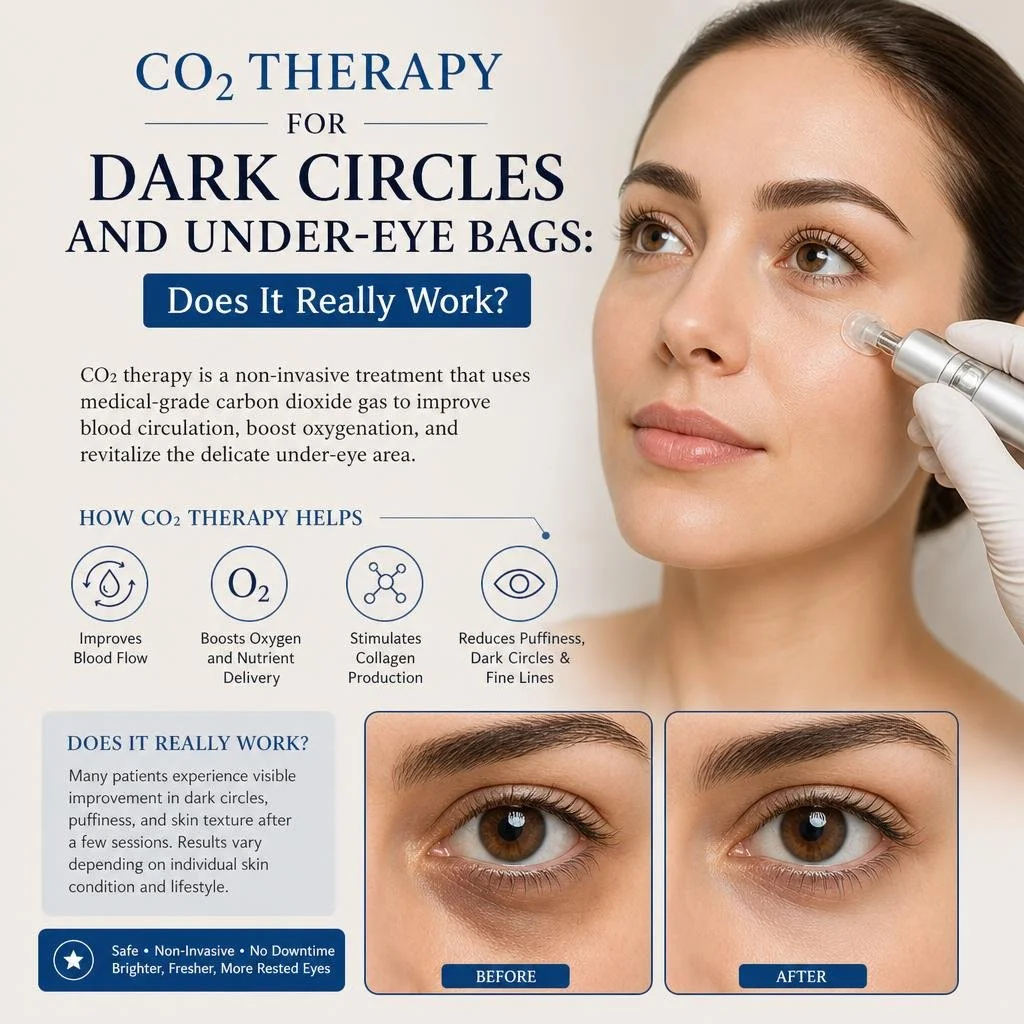
The honest answer is: it depends entirely on what's actually causing the darkness or puffiness under your eyes — and most people asking this question have never had that distinction explained to them.
"Dark circles" and "under-eye bags" get used interchangeably in everyday conversation, but they describe genuinely different conditions with different anatomical causes. Treating one condition with a therapy designed for the other is the single most common reason people try a treatment, don't see the result they expected, and conclude it doesn't work — when the real problem was a mismatch between the treatment and the actual condition.
CO2 therapy — carboxy treatment, delivered topically through a gel mask — has real, peer-reviewed clinical evidence behind it for some specific under-eye conditions. For others, no amount of CO2, however well-formulated, will produce the result you're hoping for. I want to walk through exactly which is which, because that distinction is the entire answer to whether this treatment is worth trying for you.
First: What's Actually Under Your Eyes — Four Different Problems
Before any treatment conversation makes sense, you need an accurate read on what's actually happening anatomically. The skin under your eyes is roughly 0.5 millimeters thick — about a quarter of the thickness of skin elsewhere on your face — with fewer oil glands, minimal collagen, and almost no subcutaneous fat cushioning it. This thinness is why the undereye area shows problems that wouldn't be visible anywhere else on the face. But "showing a problem clearly" doesn't mean every problem it shows has the same cause.
Vascular dark circles. Blood vessels run close to the surface in this thin skin. When those vessels carry deoxygenated blood — which is naturally darker, more blue-purple than oxygenated blood's bright red — that color shows through the translucent skin as darkness. This type of dark circle often worsens with poor sleep, allergies, dehydration, and the chronic eye-rubbing that allergy sufferers do, all of which affect local circulation and vessel dilation.
Pigmented dark circles. Excess melanin deposits in the thin undereye skin create a brown or grayish-brown discoloration that's distinct from the blue-purple of vascular circles. This type is more common in medium to darker skin tones, runs strongly genetic — a study published in the Anais Brasileiros de Dermatologia found family history was the most significant factor associated with dark circles, with average onset around age 24 — and tends to worsen with sun exposure, which is a significant factor for South Florida residents regardless of skin tone.
Structural hollowing. As we age, the bone structure around the eye socket gradually resorbs, and the fat pads that once cushioned the area thin and shift. This creates a hollow, shadowed appearance that reads as darkness even though there's no actual pigment or vascular issue — it's a shadow cast by the contour of the face, the same way a hollow cheek creates shadow under harsh lighting.
True under-eye bags — fat herniation. This is an entirely different anatomical problem from any dark circle type. The eye sits in a bony socket cushioned by fat pads, held in place by a thin membrane called the orbital septum. As this septum weakens with age, the fat pads it was containing push forward against the thin lower eyelid skin, creating a visible, persistent bulge. This is a structural displacement, not a circulation or pigmentation issue — and it is present regardless of how much sleep you get or how hydrated you are.
Fluid-related puffiness. Separate from fat herniation, fluid can accumulate in the loose periorbital tissue due to sodium intake, lying flat during sleep, allergies, or inefficient lymphatic drainage. This type of puffiness is temporary and typically more pronounced in the morning, improving as the day goes on and the fluid redistributes — distinct from the permanent, position-independent bulge of true fat herniation.
Most people have some combination of these. A genetic predisposition toward thin, vascular-visible undereye skin combines with structural hollowing as they age, sometimes alongside fluid retention from a salty dinner the night before. The treatment that addresses one component does nothing for the others — which is exactly why "does CO2 therapy work for dark circles" doesn't have a single yes-or-no answer.
What CO2 Therapy Actually Does — and Which Conditions It Reaches
Carboxy therapy works through a specific, well-documented mechanism: CO2 introduced to the skin reacts with water in the blood plasma to form carbonic acid, lowering local tissue pH. This pH change triggers the Bohr effect — hemoglobin releases oxygen more readily under acidic conditions — producing increased oxygenation of the local tissue, vasodilation that increases blood flow, and over a series of treatments, neoangiogenesis: the growth of new capillaries.
This mechanism maps directly onto vascular dark circles. The treatment increases oxygen delivery to the blood flowing through the undereye capillaries, which changes the color of what's showing through the thin skin — from the darker deoxygenated blue-purple toward a brighter, less visible red-pink. Over a series of treatments, the neoangiogenesis effect improves the capillary architecture in the area, reducing the chronic pooling of deoxygenated blood that perpetuates vascular darkness. The clinical research is specific and positive here: a 2024 study published in the Journal of Cosmetic Dermatology found that all patients studied experienced significant reduction in dark circle severity after the third carboxy session, with results statistically significant at p < 0.001. A separate prospective study of 35 patients receiving carboxytherapy for dark circles found significant reduction in skin discoloration across all participants.
For fluid-related puffiness, the mechanism is less direct but still relevant: the vasodilation and increased circulation from carboxy therapy can support better lymphatic-adjacent fluid movement in the treated tissue, though this isn't the primary documented mechanism in the carboxy research literature, which focuses on the vascular and collagen effects rather than lymphatic drainage specifically. Clients with mild puffiness sometimes notice improvement, but this is a secondary benefit rather than carboxy therapy's core documented action.
For pigmented dark circles, carboxy therapy's effect is more indirect. The treatment doesn't break down melanin or lighten pigmentation directly the way a tyrosinase-inhibiting ingredient (like niacinamide or hydroquinone) does. What it can do is improve the overall vascular contribution layered on top of pigmentation — many clients have both vascular and pigmented components simultaneously, and reducing the vascular darkness can make the remaining pigmented component look proportionally less severe, even though the pigment itself hasn't changed. This is a real but partial benefit, and it's important to be honest that carboxy therapy is not a depigmenting treatment.
For structural hollowing and true fat herniation bags, carboxy therapy does not address the underlying anatomy. It cannot restore lost bone volume, rebuild fat pad cushioning, or strengthen a weakened orbital septum to hold herniated fat back in place. A client whose primary undereye concern is the visible bulge of fat herniation will not see that bulge reduce from carboxy treatment, regardless of how many sessions they complete. This is a structural problem requiring either dermal filler to restore lost volume around the hollow, or blepharoplasty — surgical removal or repositioning of the herniated fat — for the bulge itself.
Why This Distinction Matters More Than the Marketing Suggests
I want to be direct about why "CO2 therapy for dark circles and under-eye bags" as a marketing phrase creates a problem: it groups together a condition the treatment genuinely helps (vascular dark circles) with a condition it cannot meaningfully address (fat herniation bags) under a single promise.
This isn't unique to carboxy therapy — it's a pattern across the entire undereye treatment industry. Red light therapy marketing makes a similar combined claim, and the honest research on red light shows the same split: it can modestly help vascular dark circles and mild fluid puffiness through improved microcirculation, but it cannot correct structural fat herniation or deep hollowing, which require surgical or filler intervention respectively. Eye creams marketed for "dark circles and puffiness" face the same honesty gap — caffeine-based formulations provide genuine vasoconstrictive benefit for vascular darkness and mild puffiness, but no topical cream reaches deep enough to affect herniated fat or bone resorption.
The reason this matters practically: a client with primarily structural fat herniation who tries a series of carboxy treatments expecting bag reduction will conclude, reasonably, that the treatment doesn't work — when the actual problem is that her specific undereye presentation doesn't match what the treatment's mechanism can reach. This isn't a failure of carboxy therapy. It's a failure of accurate diagnosis before treatment, which is exactly the gap a proper consultation is supposed to close.
How to Tell Which Type You Have — Before You Book Anything
There's a simple self-assessment that helps clarify which category you're likely dealing with, though a proper professional assessment under good lighting is more reliable.
The press test for bags versus puffiness: gently press the skin under your eye. If there's a firm bulge that doesn't compress or shift, and it's present consistently regardless of time of day or how much sleep you got, that's more likely structural fat herniation. If the area feels softer and the appearance varies — worse in the morning, better by afternoon, worse after a salty meal or poor sleep — that's more consistent with fluid retention.
The stretch test for vascular versus pigmented darkness: gently stretch the skin under your eye taut with two fingers. If the darkness lightens noticeably when the skin is stretched, the discoloration is likely vascular — the stretching is temporarily reducing visible blood pooling. If the darkness persists unchanged regardless of stretching, it's more likely pigmentation-based, sitting in the melanin of the skin itself rather than in the blood vessels beneath it.
The smile test for bags versus hollowing: smile broadly and watch whether the under-eye area changes shape. A bulge that becomes more prominent with the cheek muscle's movement during a smile suggests fat herniation interacting with the orbicularis oculi muscle. A shadow that doesn't change shape with expression is more consistent with structural hollowing from volume loss.
None of these tests are diagnostic in the clinical sense, but they give you a reasonable starting hypothesis before booking a treatment — and they're exactly the kind of assessment I do, more thoroughly and under proper lighting, during a consultation before recommending carboxy therapy, filler, or referring out for surgical evaluation.
What a Realistic Carboxy Treatment Plan Looks Like for Each Type
For clients whose primary concern is vascular dark circles — confirmed by the stretch test showing improvement, or simply by a history of the darkness worsening with poor sleep and improving with rest — carboxy therapy is a strong, evidence-supported option. I typically recommend three sessions as an initial assessment period, consistent with the clinical research protocol that showed significant improvement at the third session. Sessions are spaced about a week to two weeks apart for the undereye area specifically, with maintenance monthly afterward for clients who want to sustain the improvement.
For clients with a mixed presentation — some vascular component alongside mild pigmentation or early structural changes, which describes a large proportion of clients in their late thirties and forties — carboxy therapy addresses the vascular layer meaningfully, and I'm honest that the remaining pigmentation or early hollowing will need a different approach (brightening actives for pigment, filler consultation for hollowing) to fully resolve. Carboxy therapy in this case is one part of a combination plan, not a complete solution on its own.
For clients whose self-assessment and my professional assessment both point toward true fat herniation — a firm, position-independent bulge that doesn't respond to the press test the way fluid retention does — I tell them directly that carboxy therapy will not reduce that specific bulge, and that the appropriate next step is a consultation with a board-certified oculoplastic surgeon or dermatologist about blepharoplasty or other structural options. I would rather lose that booking than have a client spend money on a series of treatments that can't deliver what she's hoping for.
For clients with primarily fluid-related morning puffiness, I'm honest that lifestyle factors — sodium intake, sleep position, allergy management — will likely produce more noticeable improvement than any in-office treatment, and that carboxy therapy's contribution here is secondary and modest rather than primary.
The South Florida Factor in Undereye Concerns
A few elements of South Florida life specifically affect undereye presentation in ways worth mentioning.
Sun exposure accelerates both pigmented dark circles and the thinning of the already-delicate undereye skin that makes vascular darkness more visible. Clients who have spent years in South Florida's UV environment, particularly without consistent use of an eye-specific SPF or UV-blocking sunglasses, often show a combination of pigmentation and increased vascular visibility from chronic sun-driven skin thinning.
Allergies — seasonal and environmental — are a significant factor in South Florida given the regional plant life and humidity-supported mold and dust mite populations. Chronic allergy-related eye rubbing dilates the small vessels in the undereye area and can perpetuate or worsen vascular darkness; addressing allergy management alongside any cosmetic treatment often produces better overall results than the cosmetic treatment alone.
Hydration and heat-driven sodium loss through sweat can paradoxically contribute to fluid retention patterns for some clients — dehydration triggers the body's fluid retention response, which can show up as undereye puffiness in a humid, hot climate where daily fluid loss through sweat is higher than people realize.
The Honest Bottom Line
CO2 therapy genuinely works for vascular dark circles, with real peer-reviewed clinical evidence behind the specific mechanism and documented results after a short series of treatments. It provides modest secondary benefit for fluid-related puffiness. It offers indirect, partial benefit for pigmented dark circles when a vascular component is also present. And it does not address structural fat herniation bags or significant volume-loss hollowing, which require different interventions entirely.
"Does it really work" is the right question to ask before booking any undereye treatment. The honest answer requires knowing which of these conditions you actually have — and a treatment that's wrong for your specific anatomy will disappoint you regardless of how much research supports it for someone else's.
Carboxy Therapy is available starting at $55, with Carboxy Therapy Full Face at $65 and carboxy mask included in the $110 Luxury Facial. A proper undereye assessment is part of every consultation. Book at heragencyusa.com — Phenix Salon Suites, 7112 Beracasa Way, Suite 119, Boca Raton. Serving Delray Beach, Coral Springs, Coconut Creek, Parkland, Pompano Beach, and across South Florida.
Frequently Asked Questions: CO2 Therapy for Dark Circles and Under-Eye Bags
Q1: Does CO2 (carboxy) therapy actually work for dark circles?
For vascular dark circles specifically — caused by deoxygenated blood showing through the thin undereye skin — yes, with documented clinical evidence. CO2 therapy triggers the Bohr effect, increasing oxygen release from hemoglobin and improving the color of blood visible through the skin, while building improved capillary architecture over a series of treatments through neoangiogenesis. A 2024 clinical study published in the Journal of Cosmetic Dermatology found all patients studied experienced significant reduction in dark circle severity after the third carboxy session (p < 0.001). For pigmented dark circles caused by melanin deposits, the effect is more indirect — carboxy therapy doesn't break down pigment directly, though reducing a co-existing vascular component can make overall darkness look improved. The key distinguishing test: gently stretch the skin under your eye. If the darkness visibly lightens, vascular component is significant and carboxy therapy is likely to help meaningfully. If the darkness doesn't change with stretching, the pigmented component dominates and other treatments targeting melanin will be more directly effective.
Q2: What's the difference between dark circles and under-eye bags — are they the same problem?
No, they're anatomically distinct conditions, frequently confused because they occur in the same location. Dark circles are a discoloration issue — caused by visible blood vessels (vascular type), melanin deposits (pigmented type), or shadowing from structural hollowing. Under-eye bags are a volume and structure issue — caused either by orbital fat herniation (the fat pads behind the eye pushing forward through a weakened membrane called the orbital septum, creating a permanent bulge) or by fluid retention (temporary swelling from sodium intake, sleep position, or allergies, which fluctuates throughout the day). A simple test distinguishes them: press gently on the area. A firm, unchanging bulge regardless of time of day suggests fat herniation; a softer area that's worse in the morning and improves later suggests fluid retention. These four conditions — vascular darkness, pigmented darkness, fat herniation bags, and fluid puffiness — often occur in combination, and each responds to different specific treatments.
Q3: Can CO2 therapy get rid of under-eye bags caused by fat herniation?
No. This is the most important honest distinction in the entire CO2 therapy conversation for undereye concerns. Fat herniation bags are a structural problem: the thin membrane (orbital septum) that normally holds the orbital fat pads in place weakens with age, allowing the fat to push forward and create a permanent, visible bulge beneath the eye. This bulge is present regardless of sleep, hydration, or time of day, and it does not respond to circulation-based or oxygenation-based treatments because the problem isn't circulation — it's displaced tissue volume. Carboxy therapy's mechanism (CO2-triggered vasodilation and oxygenation) has no effect on the structural integrity of the orbital septum or the position of the fat pads behind it. Addressing true fat herniation bags requires either dermal filler to camouflage the transition between the bulge and the hollow beneath it, or blepharoplasty — a surgical procedure that removes or repositions the herniated fat directly. Any treatment claiming to reduce structural fat herniation bags without surgical or filler intervention should be evaluated skeptically.
Q4: How many CO2 therapy sessions does it take to see results for dark circles?
Clinical research on carboxytherapy for periorbital dark circles consistently uses a three-session protocol, with significant improvement documented after the third session. A 2024 study found all patients studied reported significant reduction in dark circle severity at this point, with results that were statistically significant. Sessions for the undereye area specifically are typically spaced one to two weeks apart during the initial series, allowing the cumulative neoangiogenesis and oxygenation effects to build progressively. A single session produces an immediate but temporary improvement — the oxygenation effect brightens blood color right away, but this fades over days without the cumulative structural improvement (new capillary growth, improved vascular architecture) that the full series provides. Evaluating CO2 therapy's effectiveness after only one session, before reaching the third-session mark that the research specifically documents, doesn't give the treatment a fair assessment of its actual mechanism.
Q5: Is CO2 therapy safe for the delicate skin under the eyes?
Yes, with appropriate technique and product formulation specifically designed for periorbital application. The undereye skin is approximately 0.5 millimeters thick — roughly a quarter the thickness of skin elsewhere on the face — with minimal collagen and almost no subcutaneous fat cushioning, making it more sensitive to aggressive treatments. Carboxy therapy's mechanism works through chemical reaction (CO2 forming carbonic acid, lowering pH, triggering the Bohr effect) rather than through heat, abrasion, or injection, which makes it gentler than many alternative undereye treatments like aggressive lasers or microneedling in this specific area. The treatment should be applied carefully around the orbital bone with attention to avoiding direct contact with the eye itself. Mild tingling and temporary redness from vasodilation are normal and resolve within an hour or two. Clients with active eye infections, recent eye surgery, or significant skin barrier compromise in the periorbital area should mention this during consultation before any treatment is applied.
Q6: What causes dark circles to get worse, and can CO2 therapy address those causes?
Dark circles worsen from several factors depending on type. For vascular dark circles: poor sleep, dehydration, allergies, and chronic eye rubbing all increase vascular dilation and visibility, worsening the darkness. CO2 therapy addresses the visible result of these factors (improving blood oxygenation and capillary health) but doesn't address the underlying triggers — getting adequate sleep, managing allergies, and staying hydrated remain necessary alongside any cosmetic treatment for lasting improvement. For pigmented dark circles: sun exposure, genetics, and skin friction (from rubbing) worsen melanin deposition. CO2 therapy doesn't directly address pigment formation, though daily SPF use specifically on the periorbital area is an important preventive measure that complements any in-office treatment. For structural hollowing: aging and bone resorption are the primary drivers, and CO2 therapy doesn't slow or reverse this structural change. A complete approach to dark circles addresses both the underlying causes (sleep, allergies, sun protection) and the cosmetic treatment (carboxy therapy for the vascular component) simultaneously.
Q7: Does CO2 therapy help with under-eye puffiness from fluid retention?
Carboxy therapy provides modest secondary benefit for fluid-related puffiness, though this isn't the treatment's primary documented mechanism. The vasodilation and improved circulation from the CO2-triggered Bohr effect may support better fluid movement in the treated tissue, but the carboxy research literature focuses specifically on vascular and collagen effects rather than lymphatic drainage mechanisms. For fluid-related puffiness specifically — the kind that's worse in the morning and improves through the day — lifestyle interventions are generally more directly effective: reducing sodium intake, sleeping with the head slightly elevated to reduce gravity-dependent fluid pooling, managing allergies that contribute to fluid accumulation, and using a cold compress in the morning to provide rapid vasoconstriction. Carboxy therapy can be a reasonable complementary treatment for puffiness when there's also a vascular dark circle component present, but it shouldn't be the primary intervention if fluid retention is the dominant concern.
Q8: How do I know if my dark circles are vascular, pigmented, or structural?
Three simple self-assessment tests provide a reasonable starting indication, though professional assessment under proper lighting is more reliable. The stretch test: gently pull the skin under your eye taut with two fingers. If the darkness visibly lightens, vascular component is significant. If unchanged, pigmentation likely dominates. The smile test: smile broadly and observe whether a bulge becomes more prominent — this suggests interaction with the orbicularis oculi muscle and possible fat herniation rather than pure discoloration. The shadow test: examine whether the darkness has a defined edge that follows the orbital bone contour (suggesting structural hollowing casting a shadow) versus a more diffuse, even discoloration across the thin skin (suggesting vascular or pigmented causes). Many people have combinations of these — vascular plus early structural changes is common in the late thirties and forties. A professional consultation with proper lighting assessment provides a more reliable diagnosis than self-testing alone, and that diagnosis should determine which treatment — carboxy therapy, brightening actives, filler, or surgical referral — is appropriate.
Q9: What's the difference between CO2 gel mask therapy and CO2 injections for dark circles?
Both work through the same underlying mechanism — the Bohr effect, where CO2 lowers tissue pH and increases oxygen release from hemoglobin — but with different intensity and delivery routes. Injectable carboxytherapy delivers CO2 directly into the subcutaneous tissue via a fine needle, producing a more concentrated, direct effect with faster and more pronounced results, but carrying documented risks including injection-related pain, hematoma (localized bleeding), and rare complications like subcutaneous emphysema. The topical CO2 gel mask delivers carbon dioxide transdermally through the skin surface, producing a similar mechanism at lower intensity — research describes the topical approach as producing "increased microcirculation and capillary growth similar to" injectable CO2, without the injection-related risks. For the delicate undereye area specifically, many clients and practitioners prefer the topical gel mask precisely because it avoids needle-related risk in a particularly thin and sensitive skin zone, accepting a more gradual treatment timeline in exchange for that safety profile.
Q10: Where can I get an honest assessment of which under-eye treatment I actually need in Boca Raton?
Her Agency at Phenix Salon Suites, 7112 Beracasa Way, Suite 119, Boca Raton, FL 33433 offers carboxy therapy specifically for vascular dark circles and mild puffiness, alongside an honest diagnostic conversation about which of the four distinct undereye conditions — vascular darkness, pigmented darkness, structural hollowing, or fat herniation bags — actually applies to your specific presentation. The consultation includes assessment under proper lighting and the self-test indicators (stretch test, press test, smile test) evaluated professionally before any treatment is recommended. For clients whose primary concern is fat herniation or significant structural hollowing, an honest referral to an appropriate specialist — oculoplastic surgeon for blepharoplasty, or filler consultation for volume restoration — is part of that assessment rather than booking a treatment that won't address the actual anatomy. Services are available to clients throughout South Florida: Delray Beach, Coral Springs, Coconut Creek, Parkland, Pompano Beach, and Fort Lauderdale. Consultations and bookings at heragencyusa.com.
