
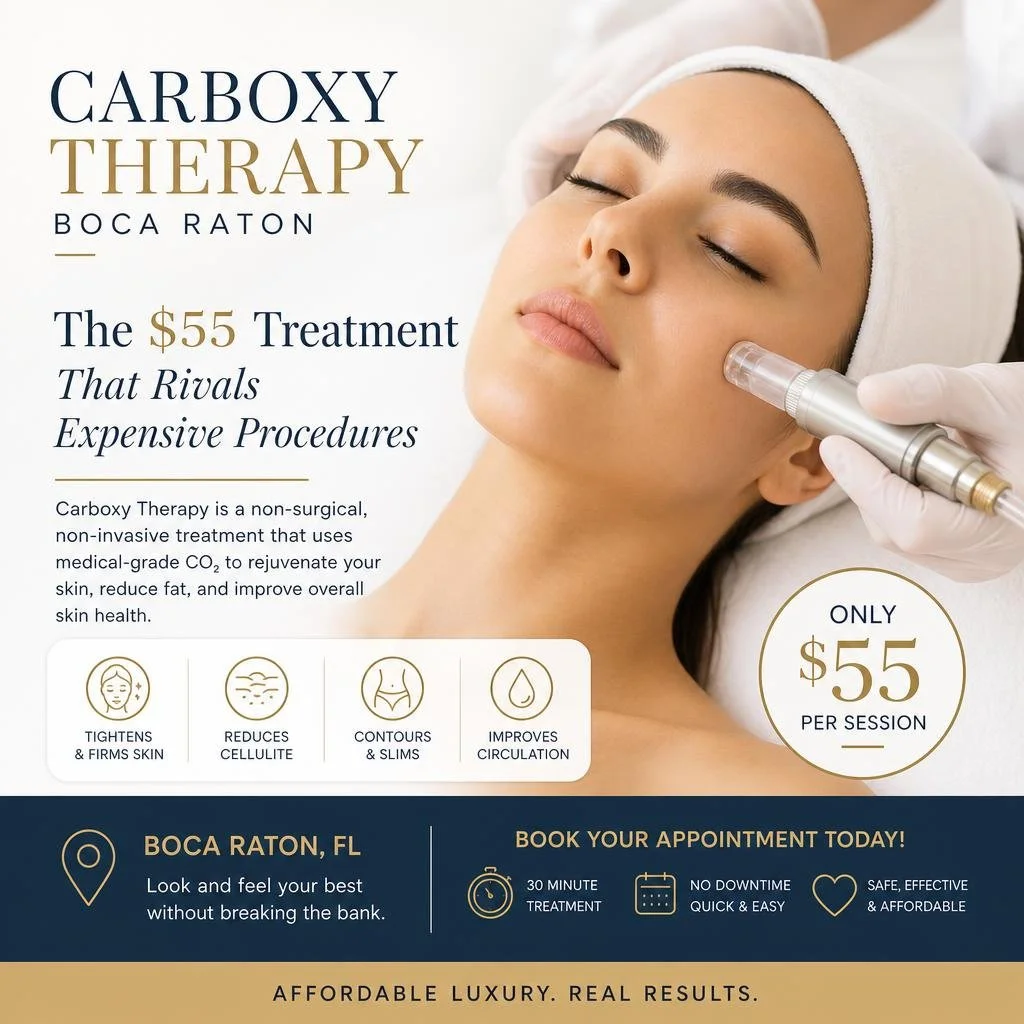
I want to be careful with the claim in that headline, because I've spent this entire career being annoyed by skincare marketing that promises a $50 treatment does what a $2,000 treatment does. Most of the time, it doesn't. The physics and biology are usually not on the side of the cheaper option, and pretending otherwise wastes a client's time and money on something that won't deliver what they actually need.
So let me be precise about where carboxy therapy genuinely rivals far more expensive procedures, and where it doesn't — because the honest version of this comparison is more useful than the marketing version, and it's also, I think, considerably more interesting.
Carboxy therapy at $55 does not replace Botox. It does not replace dermal fillers. It does not replace ablative laser resurfacing. These treatments work through mechanisms carboxy therapy doesn't touch — muscle paralysis, volume restoration, controlled thermal injury. For the specific things they do, they remain the right tools.
What carboxy therapy does rival — genuinely, by mechanism, with research behind it — is the category of treatments aimed at skin quality, circulation, oxygenation, and mild-to-moderate collagen stimulation. In that category, a $55 carboxy session is working through the same physiological pathway that $300-per-session radiofrequency treatments and $150-per-vial growth factor serums are trying to access, often less directly than carboxy does.
What "Rivals" Actually Means Here — Mechanism, Not Marketing
The reason I can make this comparison honestly is that carboxy therapy's mechanism is well-documented and specific: CO2 introduced to the skin's capillary bed lowers local tissue pH, triggers the Bohr effect, causes hemoglobin to release oxygen more readily, and produces vasodilation and — with repeated treatment — neoangiogenesis, the growth of new capillaries. This is published, peer-reviewed physiology, not a proprietary claim from a single brand.
Several professional treatment categories aim to achieve some version of this same outcome — better circulation, more oxygen and nutrient delivery to the dermis, conditions that support fibroblast collagen production — through more expensive, more technologically elaborate means.
LED light therapy ($75–150 per session at most Boca Raton med-spas) aims to stimulate cellular activity and circulation using specific light wavelengths absorbed by mitochondria. The research on LED's circulation and collagen effects is real but generally more modest than carboxytherapy's documented vasodilation and oxygenation response, which works through direct chemical mechanism rather than photobiomodulation.
Radiofrequency facial treatments ($250–500 per session) use heat generated by radiofrequency energy to stimulate collagen production through controlled thermal injury to the dermis — a different mechanism (induced micro-injury and heat-shock response) that produces collagen stimulation, but through tissue stress rather than improved oxygenation. RF treatments also carry burn risk if not properly calibrated, a risk carboxy therapy does not carry.
Growth factor serums ($150–400 per bottle for professional-grade lines) attempt to deliver the same fibroblast-stimulating signals that improved circulation and oxygenation naturally provide, but through topically applied synthetic or biomimetic growth factor molecules that must penetrate the skin barrier to reach the fibroblasts they're meant to influence — a delivery problem that carboxy therapy's vascular mechanism bypasses by working through the blood supply directly rather than through topical penetration.
Microcurrent facial treatments ($150–300 per session) use low-level electrical current to stimulate circulation and mild muscle toning, working toward some of the same circulation goals as carboxy therapy through an entirely different physiological mechanism, generally producing a comparable immediate glow without the documented neoangiogenesis effect that carboxy's published research describes.
Comparing carboxy therapy to these treatments isn't a marketing trick. It's an honest mechanism-level comparison: multiple professional treatment categories are trying to improve circulation, oxygenation, and collagen support to the dermis. Carboxy therapy does this through one of the most direct physiological pathways available, documented in peer-reviewed research, at a price point that doesn't reflect elaborate equipment costs or extensive device amortization.
Why Carboxy Is Less Expensive — The Honest Economics
I want to explain why carboxy therapy can be priced at $55 when comparable-mechanism treatments cost considerably more, because understanding the cost structure clarifies what you're actually paying for in each case.
Radiofrequency devices used in professional facial treatments cost tens of thousands of dollars, require regular maintenance and calibration, and the treatment protocol takes specific device-operating training. The cost of the device is amortized into each session's price. LED light therapy devices, particularly professional multi-wavelength panels, represent similar equipment investment. Microcurrent devices, while less expensive than RF or LED panels, still require capital investment and ongoing calibration.
Carboxy therapy in its topical mask form requires no capital equipment beyond the gel and activating mask materials themselves — consumable products rather than amortized device infrastructure. The treatment cost is primarily the product cost and the practitioner's time, not equipment depreciation. This is the honest reason carboxy therapy can be priced accessibly while delivering a mechanism that's genuinely comparable to, and in some specific outcomes superior to, treatments priced significantly higher.
This isn't a case of carboxy being cheap because it's less effective. It's a case of carboxy being accessible because its delivery format doesn't carry the equipment overhead that other circulation-and-oxygenation treatments do.
Where Carboxy Genuinely Outperforms More Expensive Alternatives
I want to highlight the specific situations where research suggests carboxy therapy isn't just comparably effective to pricier treatments, but may actually be the better choice.
Periorbital dark circles. This is the area with the strongest carboxy-specific clinical evidence, and it's also an area where expensive alternatives carry real risk. Q-switched laser treatments for dark circles — commonly recommended at $300–600 per session — carry documented risk of post-inflammatory hyperpigmentation, particularly in medium to darker skin tones, which describes a substantial portion of South Florida's population. Carboxy therapy's mechanism — improving the oxygenation of blood in undereye capillaries and gradually improving capillary architecture through neoangiogenesis — addresses the vascular component of dark circles without the hyperpigmentation risk that energy-based treatments carry. A 2024 clinical study found significant dark circle improvement in all patients studied after three carboxy sessions, with no inflammatory hyperpigmentation events reported. For dark circles specifically, carboxy therapy at $55 per session with three sessions recommended ($165 total) is a lower-risk, evidence-supported alternative to a single $400+ laser session.
Post-procedure recovery support. A randomized pilot trial published in a peer-reviewed journal evaluated carboxytherapy mask as adjunctive treatment following fractional ablative CO2 laser resurfacing — a procedure that itself frequently costs $1,000 to $3,000 and carries a recovery period with redness, swelling, and discomfort. The study found that carboxy mask application before and after the laser procedure improved healing outcomes and patient satisfaction, reducing the severity of post-procedure side effects. In this context, the $55 carboxy treatment isn't competing with the expensive laser procedure — it's making the expensive procedure recover better, faster, and with less discomfort, which is a form of value the laser treatment alone can't provide.
Maintenance between expensive procedures. Professional carboxytherapy literature documents that after more invasive interventions — chemical peels, microneedling, dermal fillers, botulinum toxin injections, PRP — carboxy treatment is frequently used as a complementary therapy, applied two to ten days after the primary procedure to support healing and enhance results. For clients who invest in Botox or fillers periodically, monthly carboxy sessions in between maintain skin oxygenation and circulation quality at a fraction of the cost of repeating the more expensive intervention more frequently.
Where Expensive Procedures Remain the Right Choice — Honesty About Limits
I'd be doing my clients a disservice if I didn't draw the boundaries clearly, because the honest comparison requires acknowledging what carboxy therapy cannot do.
For dynamic wrinkles caused by muscle movement — the forehead lines, crow's feet, and frown lines that come from repeated facial expression — Botox and similar neurotoxins remain the appropriate treatment. Carboxy therapy doesn't paralyze or relax muscle activity. It addresses skin quality and circulation, not the muscular mechanism that creates expression lines. No amount of CO2 oxygenation changes how a muscle contracts.
For volume loss — hollowed cheeks, deep nasolabial folds, thinning lips — dermal fillers remain the appropriate treatment. Carboxy therapy improves the quality of the skin covering a volume-depleted area; it does not add volume. A client with significant midface volume loss who chooses carboxy therapy instead of filler will see improved skin texture and tone over the hollow area, not a filled hollow.
For deep structural scarring or significant photodamage requiring tissue ablation — severe acne scarring, deep wrinkles requiring tissue removal and regrowth — ablative laser resurfacing accesses depths and produces structural changes that carboxy therapy's vascular mechanism doesn't reach. The randomized trial on carboxy as post-laser adjunct specifically demonstrates this relationship: carboxy supports recovery from the laser procedure; it doesn't substitute for what the laser itself accomplishes.
For significant skin laxity requiring tissue tightening — sagging along the jawline, significant neck laxity — more aggressive radiofrequency or ultrasound-based tightening treatments, or surgical intervention for advanced cases, address the structural laxity that carboxy's mild collagen stimulation doesn't fully resolve.
I tell clients this directly when they come in asking whether carboxy can replace a more expensive treatment they're considering. Sometimes the honest answer is yes — for skin quality, glow, mild fine lines, and dark circles, it genuinely can. Sometimes the honest answer is no — for muscle-driven lines, volume loss, and significant structural concerns, the more expensive treatment is doing something carboxy simply doesn't do.
The South Florida Value Case
I want to make the local argument for why this value comparison matters specifically in Boca Raton, where the aesthetic treatment market is dense, competitive, and not always transparent about what different price points are actually buying.
South Florida's affluent consumer base supports an aesthetic treatment market with significant price variation for treatments addressing overlapping concerns. A client dealing with dullness, mild congestion in capillary circulation from UV damage, and early skin quality decline can spend $300 on a single radiofrequency session, $200 on a growth factor serum that may or may not penetrate effectively, or $55 on a carboxy treatment that addresses the circulation and oxygenation mechanism directly.
For clients managing a skincare budget thoughtfully — which describes most people, regardless of what the Boca Raton aesthetic market sometimes implies — understanding which expensive treatments have an accessible, mechanism-comparable alternative is genuinely useful information. It's not about avoiding investment in good skincare. It's about directing that investment toward treatments that match what your skin specifically needs, rather than toward whatever carries the highest price tag in the belief that price indicates efficacy.
I'd rather tell a client honestly that a $55 carboxy series will address her dullness and mild fine lines effectively, and that she doesn't need the $400 laser session she was considering for that specific concern, than upsell her into the more expensive treatment because it's more profitable for my business. That's not how I want to practice, and it's not how I built a twelve-year career in this field.
What a Realistic Carboxy Investment Looks Like
For clients deciding whether to invest in a carboxy series, here's the honest financial picture.
A single carboxy session is $55. A series of three sessions — the protocol supported by the dark circles research and generally appropriate for initial assessment of how your skin responds — is $165. Monthly maintenance after an initial series, ongoing, runs $55 per month, or $660 annually for twelve sessions, though most clients settle into a less frequent maintenance schedule once their initial concerns have improved.
Compare this to: a single session of RF skin tightening ($250–500), a single growth factor serum bottle lasting roughly two months ($150–400), a single Botox session for the forehead and crow's feet ($300–600, repeated every three to four months), or a single ablative laser resurfacing session ($1,000–3,000, typically needing one to two sessions with significant recovery time).
None of these comparisons suggest carboxy therapy should replace any of these treatments for the specific concerns they address. What they do suggest is that for skin quality, circulation, mild collagen support, and dark circle improvement specifically, a carboxy series costs a fraction of the alternative treatments aimed at similar mechanisms, with research support behind its efficacy and a safety profile — no thermal injury, no injection risk, no hyperpigmentation risk — that some of the more expensive alternatives don't share.
What to Expect From Your Carboxy Series
If you're considering carboxy therapy based on this comparison, here's what an honest, realistic experience looks like.
The first session establishes a baseline — how your skin responds to the CO2 mechanism, what level of tingling and warmth you experience, and what the immediate glow looks like for you specifically. Most clients see this immediate effect clearly: pink, luminous, more even-toned skin that holds for several days.
Sessions two and three build the cumulative collagen and circulation response that the research timelines describe — improved hydration becomes apparent around four weeks of consistent treatment, and improved elasticity around ten weeks. For dark circles specifically, the third session is when clinical research shows the most significant improvement becomes apparent.
After the initial series, most clients either continue monthly for ongoing skin quality maintenance, or space sessions further apart once they're satisfied with the improvement and want to maintain rather than continue building. Either approach is reasonable depending on your specific goals and budget.
What I'd discourage: trying carboxy therapy once, expecting dramatic transformation, and concluding it doesn't work when a single session produces a real but modest improvement. The research behind carboxy therapy's collagen and elasticity benefits is built on series data, not single-session data. A fair trial means giving the cumulative mechanism the number of sessions the research suggests are needed to see the full effect.
Standalone Carboxy Therapy is $55, Carboxy Therapy Full Face is $65, and carboxy mask is included in the $110 Luxury Facial. Book at heragencyusa.com — Phenix Salon Suites, 7112 Beracasa Way, Suite 119, Boca Raton. Serving Delray Beach, Coral Springs, Coconut Creek, Parkland, Pompano Beach, and across South Florida.
Frequently Asked Questions: Carboxy Therapy Value and Comparison in Boca Raton
Q1: Can carboxy therapy really replace more expensive treatments like Botox or fillers?
No, and an honest answer requires distinguishing what carboxy therapy addresses from what Botox and fillers address. Botox works by temporarily relaxing the facial muscles responsible for dynamic wrinkles — expression lines from repeated muscle movement. Carboxy therapy does not affect muscle activity; it improves circulation, oxygenation, and mild collagen stimulation in the skin. Fillers add volume to areas that have lost fat and structural support; carboxy therapy improves skin quality over an area but does not add volume. For these specific concerns — dynamic wrinkles and volume loss — Botox and fillers remain the appropriate treatments and carboxy therapy is not a substitute. Where carboxy therapy does rival more expensive treatments is in the category of skin quality, circulation, oxygenation, dark circles, and mild collagen support — concerns that radiofrequency treatments, growth factor serums, and microcurrent facials also target, often at higher cost and through less direct mechanisms.
Q2: How does carboxy therapy compare to radiofrequency facial treatments for anti-aging?
Both treatments aim to stimulate collagen production, but through different mechanisms. Radiofrequency treatments use heat energy to create controlled thermal injury in the dermis, triggering a wound-healing response that includes new collagen synthesis — this mechanism carries some risk of burns if improperly calibrated and typically costs $250 to $500 per session due to the specialized equipment required. Carboxy therapy stimulates collagen production through improved oxygenation and circulation via the Bohr effect, without thermal injury, at $55 per session using consumable gel and mask materials rather than capital equipment. Research on both mechanisms supports collagen stimulation, though radiofrequency's thermal injury approach may produce more dramatic results for significant skin laxity, while carboxy therapy's gentler vascular mechanism is well-suited to general skin quality improvement, dark circles, and maintenance between more aggressive treatments. For clients with mild to moderate concerns and budget considerations, carboxy therapy offers a lower-cost, lower-risk option targeting a complementary aspect of skin aging.
Q3: Is carboxy therapy as effective as laser treatment for dark circles?
For periorbital dark circles, carboxy therapy has strong, specific clinical research support, and it may be preferable to laser treatment for certain skin tones. Q-switched and other energy-based lasers used for dark circles can effectively target pigmentation and vascular components, but carry documented risk of post-inflammatory hyperpigmentation, particularly in medium to darker skin tones. Carboxy therapy addresses the vascular component of dark circles — improving oxygenation of blood in undereye capillaries through the Bohr effect, with neoangiogenesis improving capillary architecture over a treatment series — without the hyperpigmentation risk that energy-based lasers carry. A 2024 clinical study found significant improvement in dark circle severity in all patients studied after three carboxy sessions. For dark circles caused primarily by vascular factors rather than pigmentation, carboxy therapy at $55 per session is a strong, lower-risk evidence-supported option compared to laser treatments typically costing $300 to $600 per session.
Q4: Why is carboxy therapy so much less expensive than other skin treatments with similar goals?
The price difference primarily reflects equipment cost structure rather than efficacy difference. Treatments like radiofrequency, LED light therapy, and microcurrent facials require capital equipment costing tens of thousands of dollars, which is amortized into each session's price through ongoing maintenance, calibration, and device depreciation costs. The topical carboxy mask requires no capital equipment — the treatment cost is primarily the consumable gel and mask materials plus practitioner time. This cost structure difference allows carboxy therapy to be priced accessibly while delivering a mechanism — CO2-triggered vasodilation and oxygenation through the Bohr effect — that is well-documented in peer-reviewed research and, for certain specific outcomes like dark circles and skin oxygenation, may be more directly effective than higher-cost alternatives working toward similar physiological goals through less direct means.
Q5: Can carboxy therapy be combined with Botox, fillers, or other treatments?
Yes, and professional literature on carboxytherapy specifically describes combination protocols as effective and increasingly used. Research describes carboxy treatment applied two to ten days after chemical peels, microneedling, injection lipolysis, dermal fillers, botulinum toxin injections, and PRP treatments to support healing and enhance overall results. A randomized pilot trial found that carboxy mask application before and after fractional ablative CO2 laser resurfacing improved healing outcomes and reduced the severity of post-procedure side effects like redness and swelling. For clients who invest periodically in more expensive treatments like Botox or fillers, carboxy therapy sessions in the weeks between those treatments help maintain skin oxygenation and circulation quality, potentially extending the visual benefit of the primary treatment and supporting faster recovery when combined directly with the procedure.
Q6: What are the risks of carboxy therapy compared to injectable treatments?
Topical carboxy mask treatment has a notably favorable safety profile compared to injectable alternatives. Injectable carboxytherapy — CO2 delivered via needle into subcutaneous tissue — carries documented risks including temporary moderate pain at injection sites, hematoma (localized bleeding under the skin), and in rare cases subcutaneous emphysema (air trapped under the skin). The topical mask, which delivers CO2 transdermally rather than through injection, does not carry these injection-related risks. Compared to injectable neurotoxins (Botox), which carry small risks of asymmetry, ptosis (drooping), or bruising at injection sites, or dermal fillers, which carry risks of vascular occlusion in rare cases, the topical carboxy mask's risk profile is limited to mild, temporary tingling during application and brief redness from vasodilation that resolves within one to two hours. This makes carboxy therapy a notably lower-risk option for clients who want the circulation and oxygenation benefits without injection-related risk exposure.
Q7: Does carboxy therapy work for fine lines as well as more expensive collagen treatments?
For mild to moderate fine lines, carboxy therapy produces documented improvement through genuine collagen and elastin stimulation, though the magnitude may be more modest than treatments that create more significant tissue disruption, like microneedling or fractional laser. A 2023 pilot study found improved skin elasticity at ten weeks of CO2 mask use, reflecting actual structural collagen synthesis. For deep, established wrinkles or significant skin laxity, more aggressive treatments — microneedling with PRP, radiofrequency, or laser resurfacing — typically produce more substantial structural change because they create a stronger stimulus for tissue remodeling. Carboxy therapy is most comparably effective to expensive alternatives for general skin quality, mild fine lines, and the early stages of collagen-related skin changes, where its gentler oxygenation-driven mechanism provides genuine, research-supported improvement without the cost, downtime, or risk profile of more aggressive interventions.
Q8: Is it worth trying carboxy therapy before investing in more expensive anti-aging treatments?
For clients dealing with dullness, mild fine lines, dark circles, or general skin quality decline, starting with a carboxy therapy series before committing to a more expensive treatment is a reasonable approach with research support behind the mechanism. At $55 per session, a three-session series ($165 total) allows you to assess your skin's response to a circulation-and-oxygenation-based approach at a fraction of the cost of a single radiofrequency or laser session. For concerns specifically driven by muscle movement (expression lines) or volume loss, carboxy therapy will not produce comparable results to Botox or fillers regardless of how many sessions you complete — these require different mechanisms entirely. A proper consultation should clarify which category your primary concern falls into before you invest in either the lower-cost or higher-cost option, so that your spending matches what your skin specifically needs.
Q9: How many carboxy therapy sessions do you need before deciding if it's working?
The research behind carboxy therapy's collagen and elasticity benefits is built on series data, generally three to four sessions, not single-session results. Improved hydration becomes measurable around four weeks of consistent treatment; improved elasticity is documented at ten weeks. For dark circles specifically, clinical research shows significant improvement becomes apparent after three sessions. A single carboxy session produces a real, visible immediate effect — the oxygenation glow that holds for five to seven days — but the deeper collagen synthesis and neoangiogenesis effects that produce lasting skin quality improvement require the cumulative effect of multiple sessions. Evaluating whether carboxy therapy "works" after a single session, and concluding it doesn't because the immediate glow faded within a week, misunderstands what the treatment's research actually demonstrates. A fair trial means committing to at least three monthly sessions before assessing the cumulative result.
Q10: Where can I get affordable carboxy therapy near me in Boca Raton?
Her Agency at Phenix Salon Suites, 7112 Beracasa Way, Suite 119, Boca Raton, FL 33433 offers Carboxy Therapy starting at $55, Carboxy Therapy Full Face at $65, and carboxy mask included as part of the $110 Luxury Facial Treatment covering face, neck, and hands. All sessions are private and one-on-one with a twelve-year medical esthetician who will assess whether carboxy therapy is the appropriate treatment for your specific concern before recommending it over a more expensive alternative, or alongside one. Services are available to clients throughout South Florida: Delray Beach, Coral Springs, Coconut Creek, Parkland, Pompano Beach, Deerfield Beach, and Fort Lauderdale. When comparing affordable carboxy therapy options near you, ask whether the provider understands which concerns carboxy therapy is and isn't appropriate for — an honest answer to that question is a better indicator of quality care than the price alone. Consultations and bookings at heragencyusa.com.
